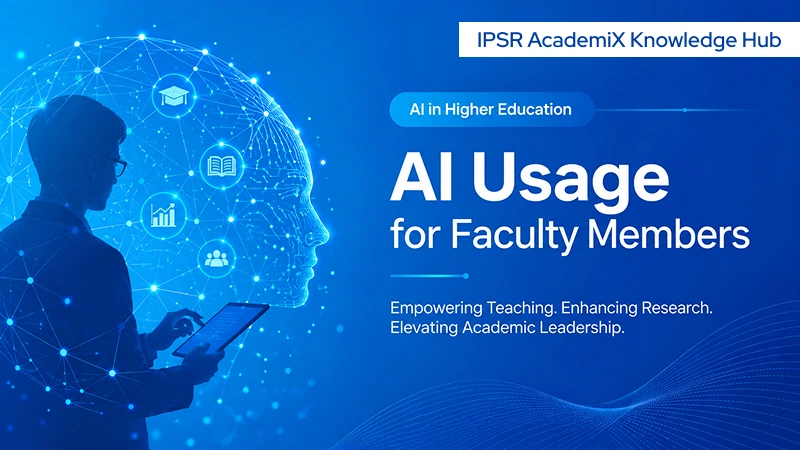
Artificial Intelligence has entered our classrooms, research labs, and academic workflows faster than most educational reforms in history. Yet, a critical question remains:
Why do some faculty members achieve transformational outcomes with AI, while others see only marginal benefits?
Recent insights from Harvard Business Review highlight a crucial shift: the best AI users don’t just “use” AI—they collaborate with it.
For faculty in Higher Education Institutions (HEIs), this distinction is not just technical—it is pedagogical, ethical, and strategic.
This article explores best practices for AI usage by faculty, grounded in research and contextualized for teaching, assessment, and academic leadership.
1. Treat AI as a Thinking Partner, Not a Shortcut
One of the most defining traits of effective AI users is that they engage in deeper, iterative conversations with AI, rather than asking one-off questions.
In academia, this translates into:
-
Using AI to challenge your lecture ideas
-
Asking AI to critique your assessment design
-
Engaging in back-and-forth refinement of concepts
Example: Instead of prompting:
“Create questions on Data Structures”
Try:
“Generate 5 questions testing higher-order thinking in Data Structures. Critique them using Bloom’s Taxonomy and suggest improvements.”
👉 This transforms AI from a content generator into a pedagogical collaborator.
2. Start with Depth, Not Speed
Contrary to popular belief, high-performing professionals are not using AI to go faster—but to think better and reduce errors.
For faculty, this is a powerful shift:
-
Draft your own lecture outline first
-
Use AI to refine, validate, and expand
-
Ask AI to identify biases, gaps, or misconceptions
Example in Research:
-
Write your abstract manually
-
Then prompt: “Critically evaluate this abstract for clarity, novelty, and research gap articulation.”
This ensures academic ownership + AI enhancement, not replacement.
3. Use AI for Cognitive Augmentation, Not Delegation
Top AI users don’t outsource thinking—they augment it.
Overreliance on AI can reduce critical thinking if not used deliberately.
Best Practice for Faculty:
|
Task |
Poor AI Use |
Effective AI Use |
|
Lecture prep |
“Generate PPT” |
“Compare 3 ways to teach this concept and suggest best pedagogy” |
|
Assessment |
“Create MCQs” |
“Design MCQs with distractors targeting misconceptions” |
|
Research |
“Write paper” |
“Identify gaps in my literature review” |
👉 The goal is intellectual amplification, not automation.
4. Be Ambitious in Academic Use Cases
Research shows that advanced users are ambitious in how they apply AI, using it beyond routine tasks.
Faculty can extend AI into:
Teaching Innovation
-
Adaptive learning pathways
-
Personalized feedback generation
-
Simulation-based learning
Assessment Transformation
-
Scenario-based evaluation
-
AI-assisted rubric design
-
Outcome-based analytics
Research Acceleration
-
Literature synthesis
-
Hypothesis refinement
-
Data interpretation assistance
Example: In Outcome-Based Education (OBE), AI can help map:
-
Course Outcomes → Program Outcomes
-
Assessment → Attainment metrics
This aligns AI with academic quality frameworks, not just productivity.
5. Design Better Prompts: Clarity Drives Quality
The best AI users write longer, more structured prompts with clear intent.
For faculty, prompt design becomes a core digital pedagogy skill.
Framework for Academic Prompts:
-
Context: “You are an experienced professor in…”
-
Task: “Design a case-based question…”
-
Constraint: “Aligned with Bloom’s Level: Analyze”
-
Output: “Include rubric and expected answer”
👉 This ensures precision, relevance, and academic rigor.
6. Maintain Academic Integrity and Accountability
AI introduces risks:
-
Hallucinated content
-
Plagiarism concerns
-
Over-standardized outputs
Research highlights that AI-generated content may be inaccurate and requires careful validation.
Faculty Responsibility:
-
Always verify AI outputs
-
Disclose AI usage where required
-
Train students in ethical AI practices
Example: Instead of banning AI in assignments, redesign tasks:
-
Reflection-based submissions
-
Viva-based validation
-
Process-oriented evaluation
👉 Shift from “AI avoidance” to “AI-aware pedagogy.”
7. Balance Human Judgment with AI Capability
AI is powerful—but it cannot replace academic judgment, experience, or contextual understanding.
In fact, the real differentiator remains:
-
Critical thinking
-
Pedagogical wisdom
-
Ethical reasoning
Example in Evaluation: AI may suggest grading criteria—but faculty must decide:
-
What constitutes “depth”
-
What reflects “original thinking”
👉 AI supports decisions; faculty define standards.
8. Build AI Literacy Across Faculty and Students
AI effectiveness is not individual—it is institutional.
Studies emphasize that AI literacy must be distributed across all roles, not limited to experts.
For HEIs:
-
Conduct Faculty Development Programs (FDPs) on AI
-
Integrate AI into curriculum design
-
Create institutional AI policies
Example:
-
AI usage guidelines for assignments
-
AI-integrated research methodology courses
👉 Institutions that embrace AI systematically will lead academic transformation.
9. Avoid the “Workslop” Trap
One emerging risk is the rise of low-quality AI-generated content, often mistaken for productivity.
For faculty, this can appear as:
-
Generic lecture slides
-
Repetitive assignments
-
Superficial research outputs
Best Practice:
-
Use AI for first drafts, not final outputs
-
Always apply expert review and refinement
👉 Quality over quantity remains the academic gold standard.
10. Redefine the Role of Faculty in the AI Era
The role of faculty is evolving:
From:
-
Content deliverer
To:
-
Learning designer
-
Critical thinking facilitator
-
AI-integrated educator
AI will not replace educators—but it will differentiate educators.
Conclusion: From AI Users to AI Leaders in Academia
The future of AI in higher education is not about tools—it is about mindset.
The best faculty members will:
-
Think deeply before prompting
-
Collaborate with AI, not depend on it
-
Uphold academic rigor while embracing innovation
In simple terms:
👉 AI can generate content. Faculty create meaning.
And in the evolving landscape of education, meaning will always matter more than output.