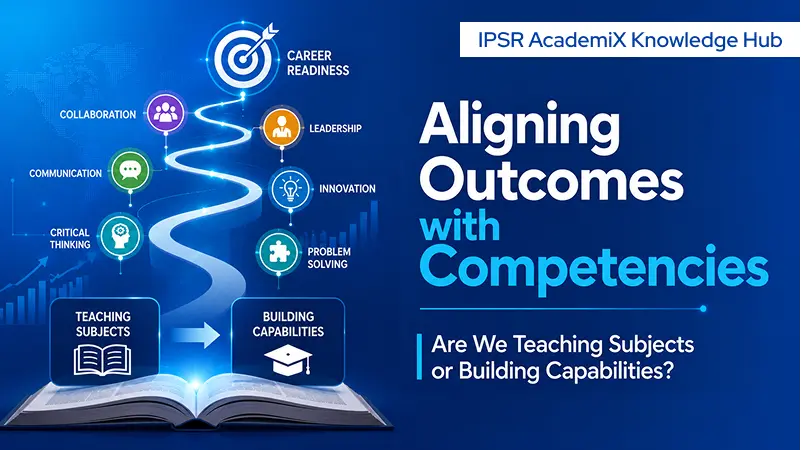
India’s higher education sector is undergoing a deep transformation. With the National Education Policy (NEP 2020), Outcome Based Education (OBE), and revised accreditation frameworks of NAAC and NBA, universities and autonomous colleges need to go beyond traditional examination systems and move towards outcome-based assessments.
In its publication, Evaluation Reforms in Higher Educational Institutions, the UGC highlights a Question Bank system that is needed to reform examinations in universities and autonomous colleges.
The UGC proposes a technology enabled question bank system to enhance the overall quality, objectivity, transparency, and effectiveness of assessments and simultaneously reduce the administrative complexities in paper-setting process. The challenge with the current system of question paper setting:
While the UGC acknowledges the value of the current practice of inviting external question paper setters for every semester, it indicates that the approach has a number of limitations in the emerging context, such as:
- Significant recurring expenditure every semester
- Coordination challenges in involving multiple paper setters
- Time-consuming paper-setting process
- Likelihood of repetition of questions
- Assessment of mere recall rather than higher order skills
- Variability in the standards and quality of question papers
- Lack of congruence with Outcome Based Education
With increasing student enrollments and interdisciplinary programs, the challenges only mount.
Why the UGC recommends a Question Bank based system
The UGC points out that with the conventional method of question paper setting, there is “likelihood of repetition of questions and also the emphasis on mere recall rather than higher cognitive skills”. The UGC further states that a “question bank, if properly designed, can be a rich repository containing items to construct standardised tests that measure intended learning outcomes more precisely and consistently”.
An effective question bank must:
- Have questions on each of the units in the syllabus
- Be mapped to LOs and COs
- Have items for all levels of Bloom’s Taxonomy
- Have questions categorized by levels of difficulty
- Have options for all types of questions (objective, short answer, descriptive)
- Have answers and metadata for all questions
- Be periodically reviewed and updated
- Be developed in consultation with faculty members and subject experts
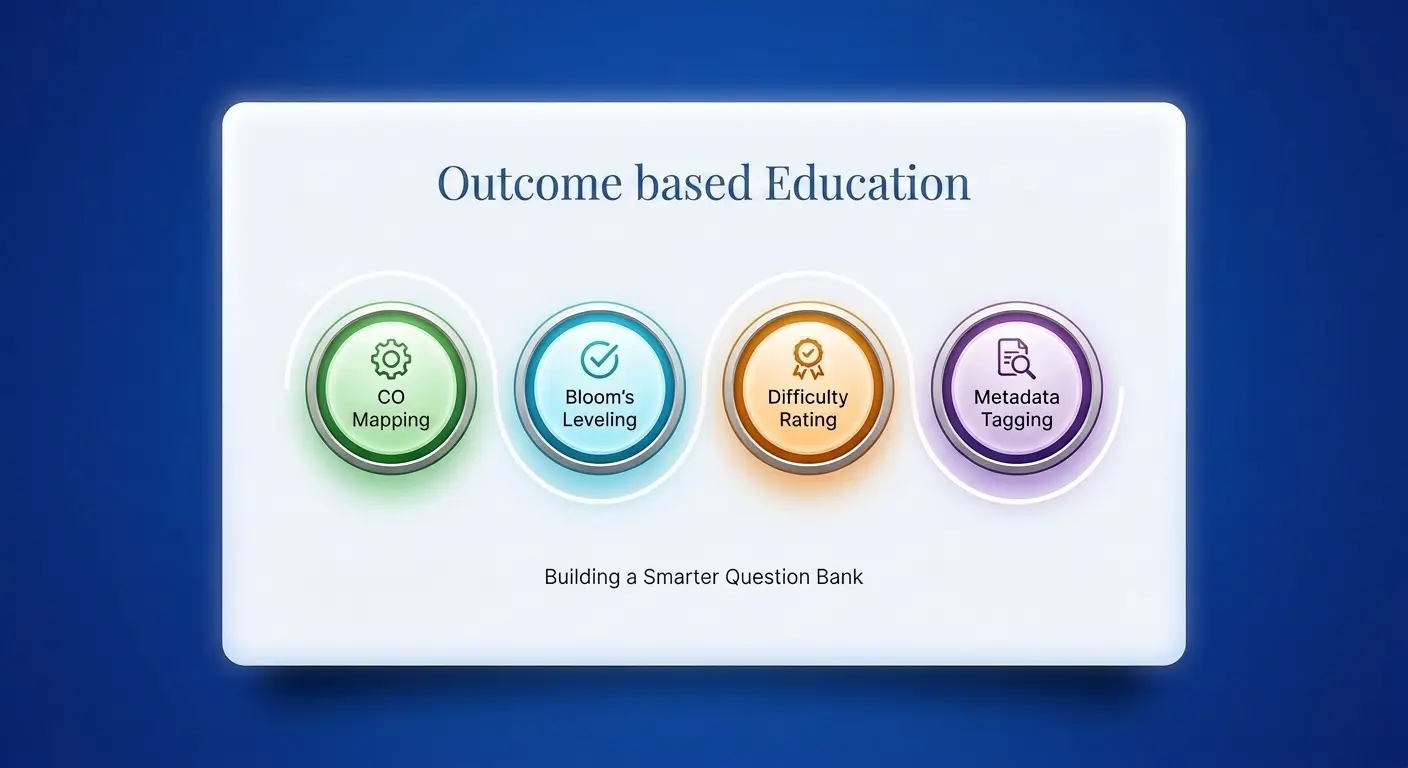
The UGC recommends that universities and autonomous colleges create question banks by conducting faculty workshops and leveraging ICT-enabled systems to generate question papers from the question bank within minutes.
A Question Bank is Much More Than Just a Question Repository
A comprehensive question bank is far more than a collection of examination questions.
It is a strategic academic asset that captures the collective expertise of faculty members, standardizes assessment quality, and supports continuous academic improvement.
A well-designed Question Bank System enables institutions to:
- Improve the quality and consistency of examinations
- Promote faculty ownership of assessments
- Strengthen Outcome-Based Education implementation
- Reduce dependency on external question paper setters
- Minimize administrative workload
- Improve confidentiality and transparency in examinations
- Enhance preparedness for NAAC and NBA accreditation
More importantly, it encourages institutions to design assessments that evaluate application, analysis, critical thinking, and problem-solving rather than simple information recall.
A question bank repository goes much beyond just being a bank of exam questions. It is a rich repository of the expertise and knowledge of the faculty involved in creating it.
A properly designed question bank offers a number of advantages such as:
- Enhanced examination quality and standardization
- Faculty ownership and faculty development
- Improved outcome-based education
- Reduction in transaction costs associated with external paper setters
- Enhanced transparency and confidentiality
- Improved preparedness for accreditation by NAAC and NBA
Most importantly, it allows universities and autonomous colleges to create outcome based assessments that go beyond rote learning and test higher order skills like application, analysis, synthesis, and evaluation.
Faculty Training for Developing a Question Bank is Intrinsic
Technology-enabled question banks are not a magic wand that enhances examination quality on autopilot. Faculty training is critical to the entire process.
As per the UGC recommendations, question bank based papers must be developed by faculty members or subject experts during faculty workshops. The faculty should be aware of the following concepts:
- Preparing questions based on Course Outcomes using Bloom’s taxonomy
- Using Bloom’s taxonomy for classifying questions according to level of difficulty
- Creating answer keys and metadata
- Peer-review of questions and question bank
- Regular updating and revision of question bank as per syllabus changes and emerging trends
The UGC recommends that universities and autonomous colleges refresh about 20% of the question bank every year to keep it up to date. Faculty members involved in the preparation of the question bank must:
- Be familiar with the concepts of COs and Bloom’s Taxonomy
- Be able to prepare questions based on Course Outcomes
- Be able to classify questions according to Bloom’s Taxonomy levels and difficulty levels
- Be able to prepare answer keys and question metadata
- Be able to participate in peer-review of questions and the question bank to maintain standards
- Be able to revise and update the question bank periodically.
Since institutions and universities can use this repository to set examination papers, faculty involvement in developing the question bank also enhances the overall quality of teaching-learning at the institution.
What to do with Question Bank – Share with Students or Not?
The UGC encourages universities and autonomous colleges to share the question bank with the students. However, the value of using questions in assessments lies in masking the usage. Questions that are used to test higher order skills such as case studies, analytical questions, etc., reveal their purpose only when shared with students. Hence, for maintaining the integrity of such assessments, institutions should allow selective disclosure of questions. While the institution may choose to share the question bank with students, faculty members may decide which questions to disclose and which to mask.The Role of AI in Modern Examination Management
Artificial intelligence is playing an important role in reimagining assessments. While it is a tool, it is one that can be leveraged by institutions and universities to enhance the quality of examinations. The most effective use of AI is in creating question banks. A properly designed question bank can be used to set examination papers on a regular basis.
AI can help faculty members in:
- Coming up with questions based on Course Outcomes
- Coming up with questions on varied levels of Bloom’s Taxonomy
- Generating questions on different levels of difficulty
- Accelerating the process of question bank preparation
- Ensuring high quality questions in the question bank.
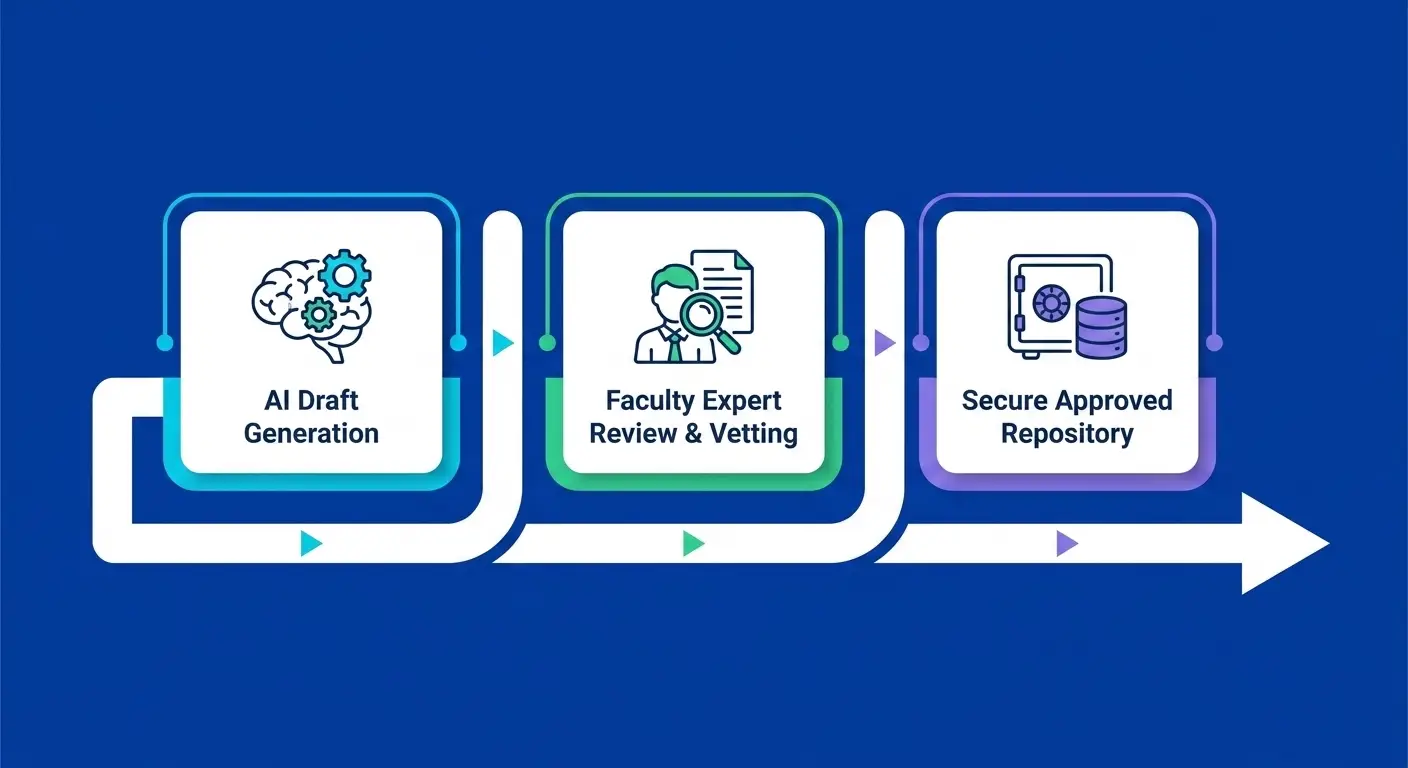
While AI can help generate questions of varied types and difficulty levels, it is ultimately the faculty that approves, reviews, and adds questions to the question bank.
Once the question bank has been prepared and approved, technology can be leveraged to set question papers from the question bank within minutes in accordance with the examination pattern, blueprint, difficulty levels, and syllabus coverage.
In other words,
Question Bank in a Day. Question Paper in a Minute.
How an Institution Can Leverage the UGC Recommendations for Enhancing Examination Quality
A robust examination system requires more than just technology. It requires an effective mix of:
- Faculty development
- Outcome-based education framework
- Standardized question paper setting process
- Appropriate quality control mechanisms
- Digital repository of question banks
- AI-assisted question bank generation
- Technology-enabled examination systems that reduce transaction costs
When these are combined, institutions and universities can enhance the overall quality of examination process.
QnSmart i 4.0: An AI-Integrated Examination Management Platform

QnSmart i has been designed to meet the requirements of the UGC recommendations for examination reforms. It helps institutions set up a comprehensive examination management ecosystem with AI-assisted question bank generation, faculty review and approval of questions, centralized digital repository of question banks, and technology-enabled generation of question papers from the question bank in accordance with the examination pattern and blueprint. The platform also facilitates:
- CO attainment support
- Documentation for accreditation and quality assurance
- Controlled sharing of question banks as per institutional policies
Many top universities and autonomous colleges are leveraging QnSmart i to implement the UGC-recommended reforms and reduce transaction costs while enhancing examination quality, faculty ownership, and effective Outcome Based Education.
Conclusion
Examination reforms have become a critical priority for universities and autonomous colleges. The UGC guidelines offer a comprehensive framework that will help institutions and universities improve the quality of education while simultaneously reducing the administrative and transaction costs in the process.
For universities and autonomous colleges, adopting a Question Bank Based Examination System is no longer optional but rather a strategic imperative that will enable them to deliver higher quality education and build sustainable examination systems for the future.
About QnSmart i
QnSmart i 4.0, from ipsr solutions limited, is an AI-Integrated and OBE-aligned Examination Management Platform developed by Senior Academicians and Professionals who are experts in OBE & AI. It empowers universities and higher education institutions to implement UGC-recommended evaluation reforms through AI-assisted question bank preparation, centralized digital question banks, outcome-based assessment practices, and instant question paper generation from approved question banks.
Question Bank in a Day. Question Paper in a Minute.