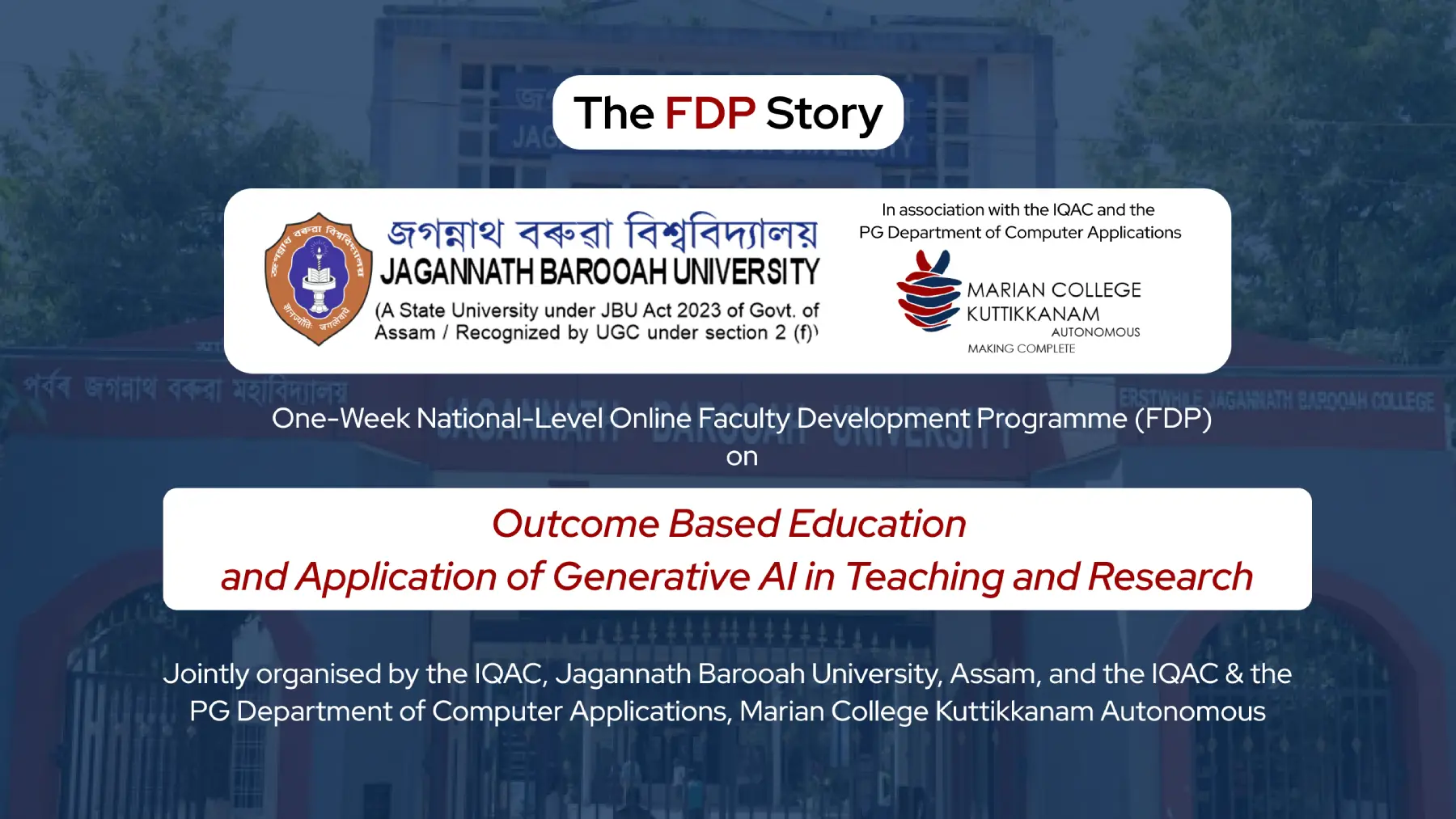
This one-week National level online FDP on OBE and Application of Generative AI in Teaching and Research was jointly organized by the Internal Quality Assurance Cell, Jagannath Barooah University, Assam, and the Internal Quality Assurance Cell and the PG Department of Computer Applications, Marian College, Kuttikkanam Autonomous in association with ipsr solutions limited.
The programme received an overwhelming response from faculty members across the country.
Programme Statistics
- Programme Duration: 23 - 30 April 2026
- Live Session Timings: 7:00 PM – 9:00 PM IST
The Faculty Development Programme received an overwhelming response from faculty members and researchers across the country. A total of 1,134 participants online representing 820 Educational Institutions, attended the sessions and 373 participants utilized the LMS.
The programme attracted participants from 25 Indian States and 2 Union Territories, along with a small number of international participants from UAE, demonstrating its wide national reach.
Introduction
About Jagannath Barooah University, Assam
Jagannath Barooah University (JBU), formerly Jagannath Barooah College, is a state university in Assam. Located in Jorhat, a culturally and historically significant city in the Brahmaputra Valley, the institution traces its origins back to 1930, playing a key role in the development of modern education in the region.
With over 95 years of legacy, JBU has evolved into a centre of academic excellence, contributing to nation-building by promoting quality education, global competencies, and innovative teaching practices. The institution has been NAAC accredited with an ‘A’ grade, granted autonomous status by UGC (2016–17), and recognized with Star College status by the Department of Biotechnology, Government of India.
About Marian College Kuttikkanam Autonomous
Marian College Kuttikkanam (Autonomous), nestled in the serene high ranges of Idukki, Kerala, stands out as a forward-looking institution committed to academic excellence and transformative education. Established in 1995 and affiliated with Mahatma Gandhi University, the college is managed by the Diocese of Kanjirapally and has consistently upheld a tradition of value-based learning blended with innovation. Since attaining autonomous status in 2016, Marian has been a pioneer in implementing Outcome-Based Education (OBE), designing its curriculum to ensure that students achieve clearly defined learning outcomes aligned with global standards and industry needs. This learner-centric approach, combined with strong industry partnerships, experiential learning, and research-driven pedagogy, empowers students with both competence and character. Accredited with the highest A++ grade by NAAC, the institution continues to shape future-ready graduates while remaining rooted in social responsibility and ethical values.
About ipsr solutions limited
IPSR is a public limited IT company led by academicians and technology experts, specializing in innovative AI platforms and smart technology solutions. With 26 years of experience, IPSR has partnered with 500+ higher education institutions, including major government universities and autonomous colleges.
Its academic solutions and mentoring services support institutions in achieving excellence and accreditation readiness through:
- Quality strategies for accreditation and rankings
- Effective OBE implementation with accurate attainment and analytics
- AI-assisted, OBE-aligned examination management systems
- AI- and critical-thinking–based research enablement
- Academic collaborations, value-added courses, and internships
- Custom, accreditation-friendly websites and web applications
Day 1 – 23 April 2026
The one-week National Level Faculty Development Program (FDP) on Outcome Based Education (OBE) and the Application of Generative AI in Teaching and Research commenced on 23 April 2026. The programme was jointly organized by Jagannath Barooah University, Marian College, Kuttikkanam (Autonomous), and ipsr solutions limited, bringing together academicians and educators from across the country to enhance their understanding of contemporary teaching methodologies aligned with the National Education Policy (NEP) 2020.
Welcome Address

The inaugural session began with a welcome address by Dr. Kalyan Das, who highlighted the growing importance of Outcome Based Education and the transition from teacher-centred to learner-centred education envisioned under NEP 2020. He emphasized the need for faculty members to adopt innovative pedagogical practices that promote measurable learning outcomes.
Presidential Address

In the presidential address, Dr. Utpal Jyoti Mahanta encouraged participants to translate the knowledge gained during the FDP into effective classroom practices and impactful research initiatives. He stressed that continuous faculty development is essential for improving the quality of higher education.
Manager’s Address

Addressing the gathering, Rev. Fr. Boby Alex Mannamplackal spoke about the collaborative efforts of the partnering institutions in equipping educators with the competencies required to implement OBE and responsibly integrate Generative AI into teaching and learning.
Inaugural Address

The programme was formally inaugurated by Prof. Jyoti Prasad Saikia. In his inaugural address, he underscored the evolving role of educators as designers of meaningful learning experiences rather than mere transmitters of syllabus content. He emphasized that clearly defined learning outcomes and innovative teaching strategies are fundamental to achieving quality education in the modern academic landscape.
Vote of Thanks

The inaugural session concluded with a vote of thanks delivered by Dr. Joby Cyriac, who reiterated the objectives of the FDP and encouraged participants to incorporate the principles of Outcome Based Education and Bloom's Taxonomy into their teaching and assessment practices.
Technical Session
Day 1 – 23 April 2026
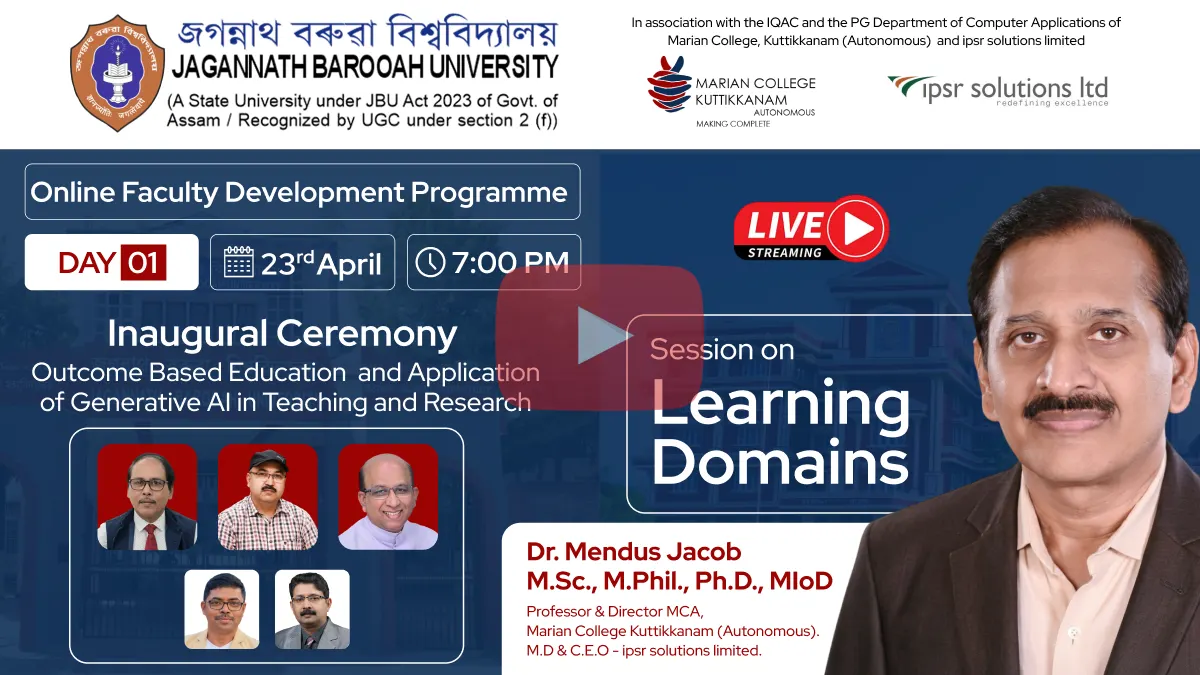
Topic: Learning Domains
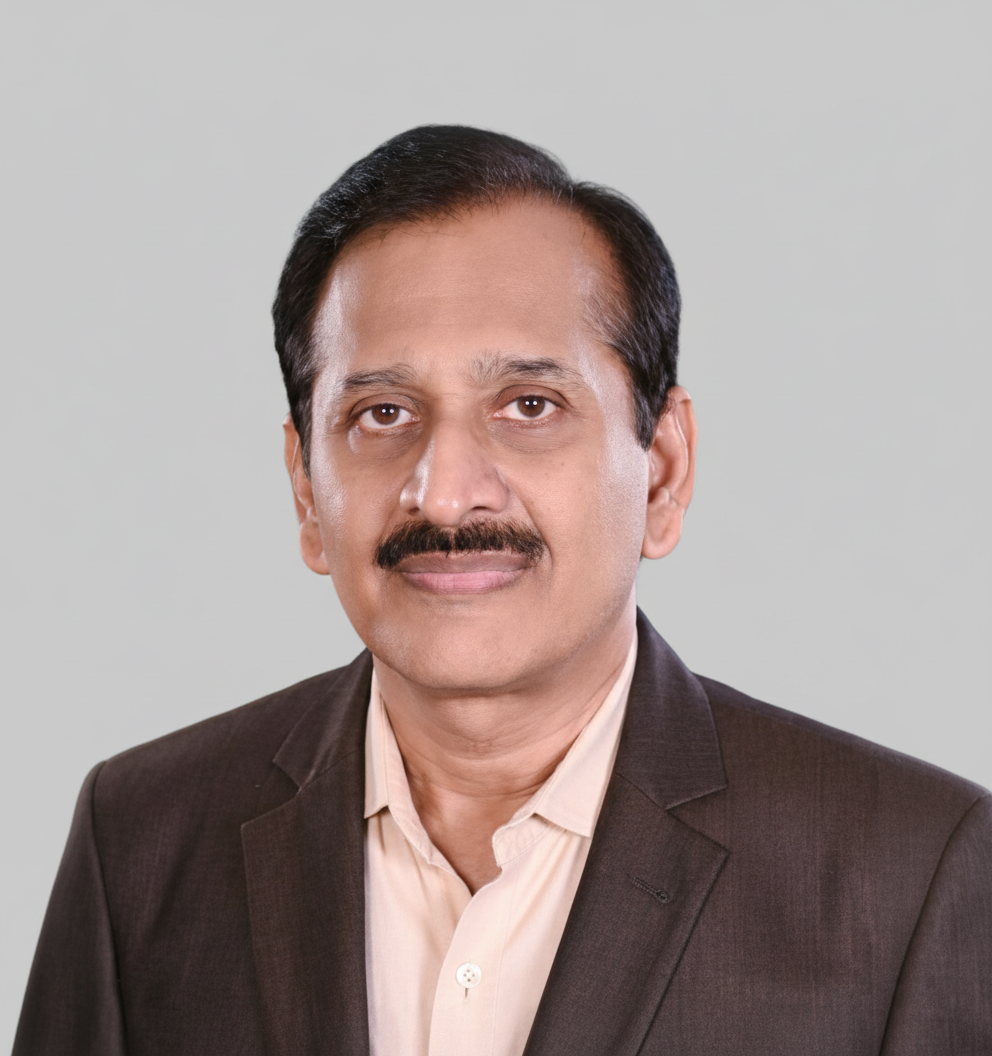

The Faculty Development Programme was formally introduced by Dr. Mendus Jacob, Professor and Director, MCA, Marian College Kuttikkanam (Autonomous), and Managing Director & CEO of ipsr solutions limited.
The first technical session was conducted by Dr. Mendus Jacob on the topic "Learning Domains and Bloom's Taxonomy." He introduced the ASK (Attitude, Skill, and Knowledge) framework as the foundation of professional competency and provided an in-depth explanation of Bloom's Taxonomy across the cognitive levels—Remembering, Understanding, Applying, Analysing, Evaluating, and Creating. Through practical examples, he demonstrated how educators can design learning outcomes and map assessment questions to the appropriate cognitive levels, enabling effective implementation of Outcome Based Education in higher education.
The inaugural day successfully established the foundation for the week-long FDP by introducing participants to the core principles of Outcome Based Education and providing practical insights into designing learner-centred teaching and assessment strategies.
Day 1 – Key Points
- Inauguration of the one-week National Level FDP on Outcome Based Education (OBE) and the Application of Generative AI in Teaching and Research.
- Speakers emphasized the importance of Outcome Based Education, learner-centred teaching, and the implementation of NEP 2020.
- Faculty members were encouraged to design meaningful learning experiences and apply the knowledge gained in teaching and research.
- The technical session by Dr. Mendus Jacob focused on Bloom's Taxonomy and the ASK (Attitude, Skill, and Knowledge) framework.
- Participants learned to formulate measurable learning outcomes and align assessment questions with Bloom's cognitive levels.
- The day provided a strong foundation for implementing OBE and effective assessment practices in higher education.
Day 1 Resources
QnSmart i 4.0 – AI-Assisted Question Bank Software for Autonomous Colleges & Universities by IPSR
Presenting QnSmart i 4.0 – an OBE-aligned & AI-assisted Question Bank Software designed for Autonomous Colleges and Universities.
Build question bank in a day and generate question papers in a minute!
- Supports NEP 2020, CBCS & Exam Reforms Policy
- Includes Higher Order Thinking Stem (HOTS) & Case-based Questions
- Accreditation-ready with CO Mapping & 75+ Reports
- Secured with Encryption & Easy Dashboard
Day 2 – 24 April 2026
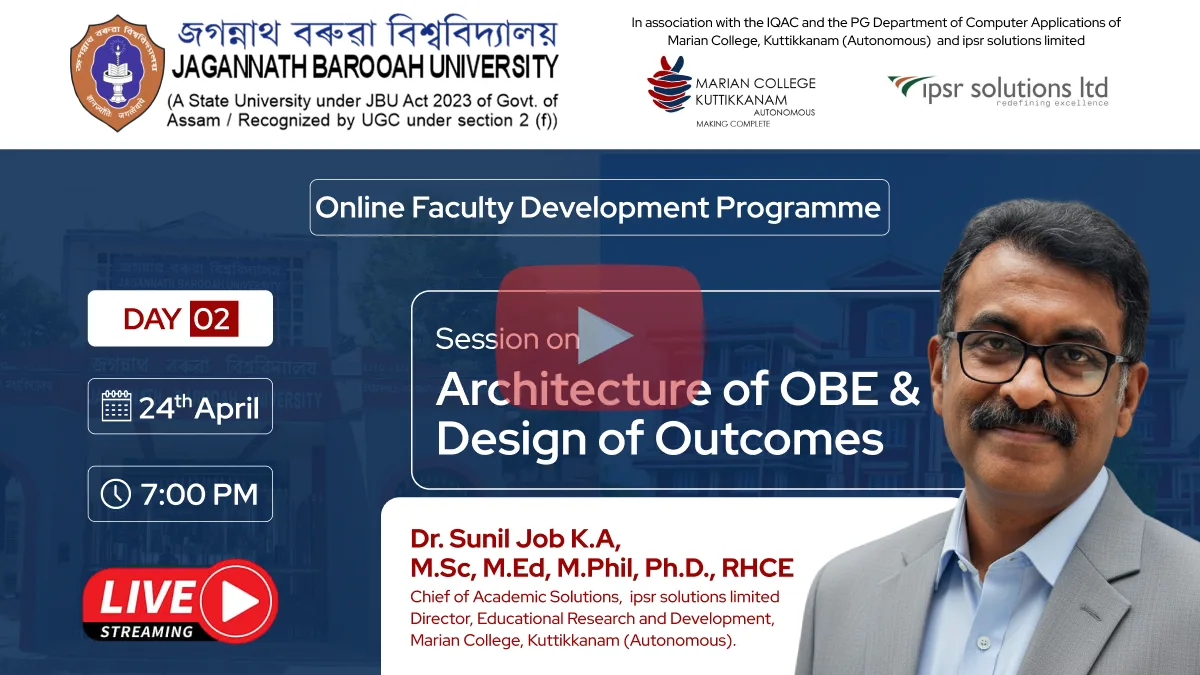
Topic: Architecture of OBE & Design of Outcomes
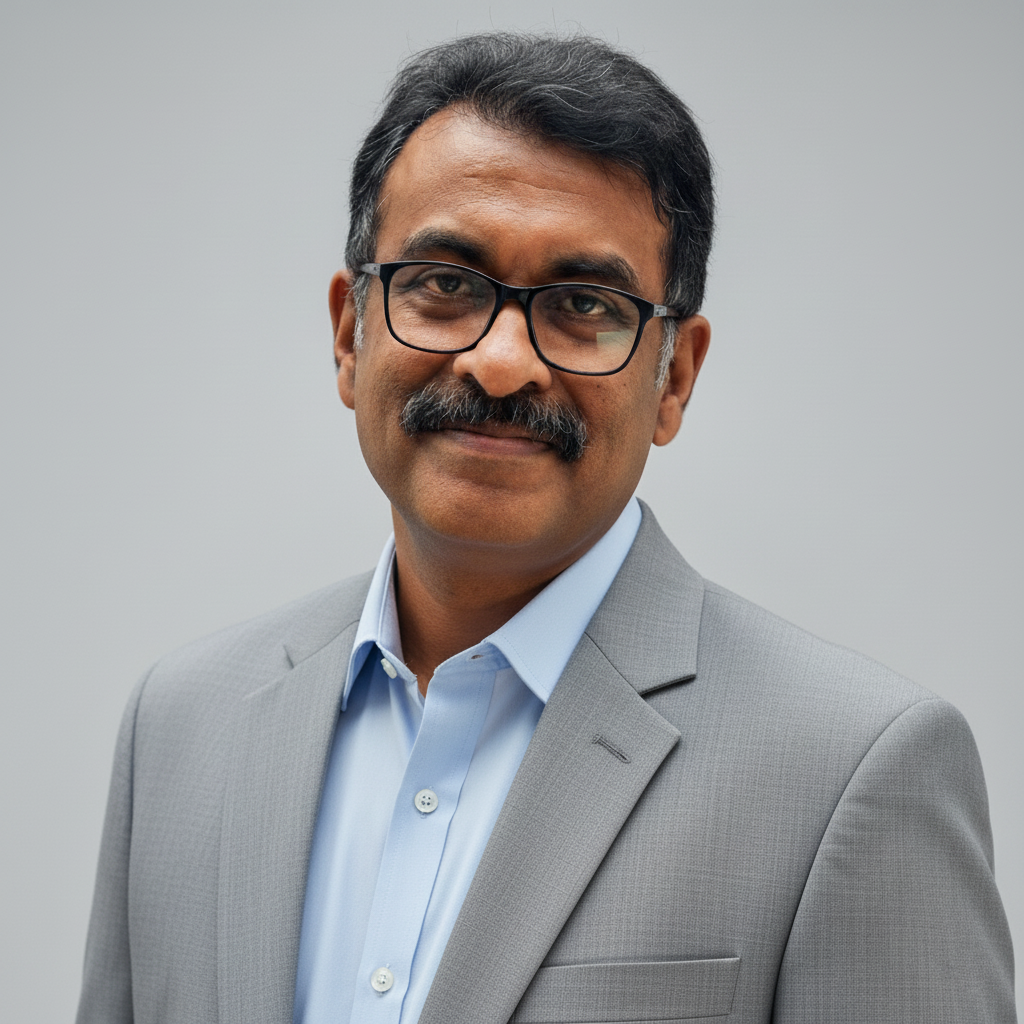
Resource Person: Dr Sunil Job KA
Chief of Academic Solutions, IPSR
Director, Educational Research and Development, Marian College, Kuttikkanam (Autonomous)
The second day of the Faculty Development Programme focused on the Architecture of Outcome-Based Education (OBE) and the Design of Learning Outcomes. The technical session was led by Dr. Sunil Job K. A., who provided participants with a comprehensive understanding of the OBE framework and its practical implementation in higher education.
The session began with an overview of the OBE architecture, explaining the alignment between an institution's Vision and Mission, Programme Educational Objectives (PEOs), Programme Outcomes (POs), and Course Outcomes (COs). Participants learned how each level contributes to achieving the intended learning outcomes and the importance of adopting a bottom-up approach to assessment.
Dr. Job also distinguished between objectives and outcomes, emphasizing that PEOs define the long-term accomplishments expected of graduates, while POs represent the measurable knowledge, skills, and competencies students should achieve by the end of their programme.
A major focus of the session was on designing effective learning outcomes. Participants were introduced to the principles of writing clear, observable, and measurable outcomes using appropriate action verbs based on Bloom's Taxonomy. A practical quality checklist was shared to help educators evaluate and refine their Course Outcomes.
The session concluded with a demonstration of Excel-based templates available through the Learning Management System (LMS), enabling participants to assess the quality and alignment of their Course Outcomes for effective OBE implementation.
Day 2 – Key Points
- Overview of the Architecture of Outcome-Based Education (OBE).
- Explained the relationship between Vision & Mission, PEOs, POs, and COs.
- Distinguished between Programme Educational Objectives (PEOs) and Programme Outcomes (POs).
- Demonstrated how to write measurable and observable Course Outcomes using Bloom's Taxonomy.
- Introduced a quality checklist for evaluating learning outcomes.
- Provided practical guidance on using LMS templates to review and improve Course Outcomes.
Outcome-Based Education (OBE) & Design of Outcomes
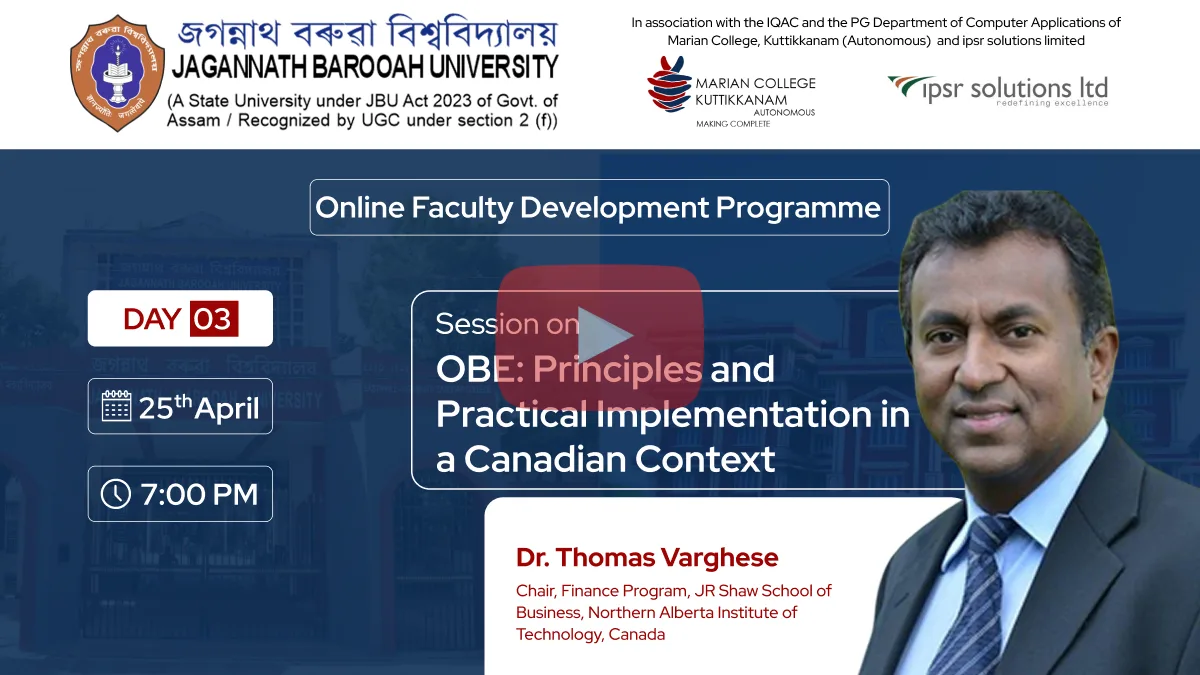
Day 3 – 25 April 2026
Topic: Practical Insights into OBE – A Canadian Perspective on Implementation
Resource Person: Dr. Thomas Varghese
The third day of the Faculty Development Program featured a technical session on "Outcome-Based Education: A Canadian Experience" delivered by Dr. Thomas Varghese. The session explored the implementation of Outcome-Based Education (OBE) in the Canadian higher education system and highlighted its role in enhancing teaching, learning, and student achievement.
Dr. Varghese explained how OBE places clearly defined learning outcomes at the centre of curriculum design, instructional planning, and assessment. Drawing on Canadian practices, he demonstrated how outcome-focused education promotes learner engagement, critical thinking, problem-solving, and the development of practical competencies. The session also emphasized the importance of aligning curriculum, teaching strategies, and assessment methods to ensure that students achieve the intended learning outcomes.
The speaker further discussed the role of continuous assessment and evidence-based evaluation in improving educational quality. By aligning assessments with predefined outcomes, educators can effectively monitor student progress, refine teaching practices, and foster a culture of continuous improvement. The session concluded by encouraging participants to adopt learner-centred approaches that prepare graduates with the knowledge, skills, and competencies required to succeed in an evolving global environment.
Day 3 – Key Points
- Explored the principles and implementation of Outcome-Based Education (OBE) through the Canadian higher education model.
- Highlighted the importance of clearly defined learning outcomes in curriculum design and assessment.
- Emphasized learner-centered teaching to promote critical thinking, problem-solving, and practical competencies.
- Demonstrated the alignment of curriculum, teaching methods, and assessment with intended learning outcomes.
- Discussed the use of evidence-based assessment to monitor student progress and improve teaching effectiveness.
- Encouraged the adoption of continuous improvement practices to enhance educational quality and graduate readiness.
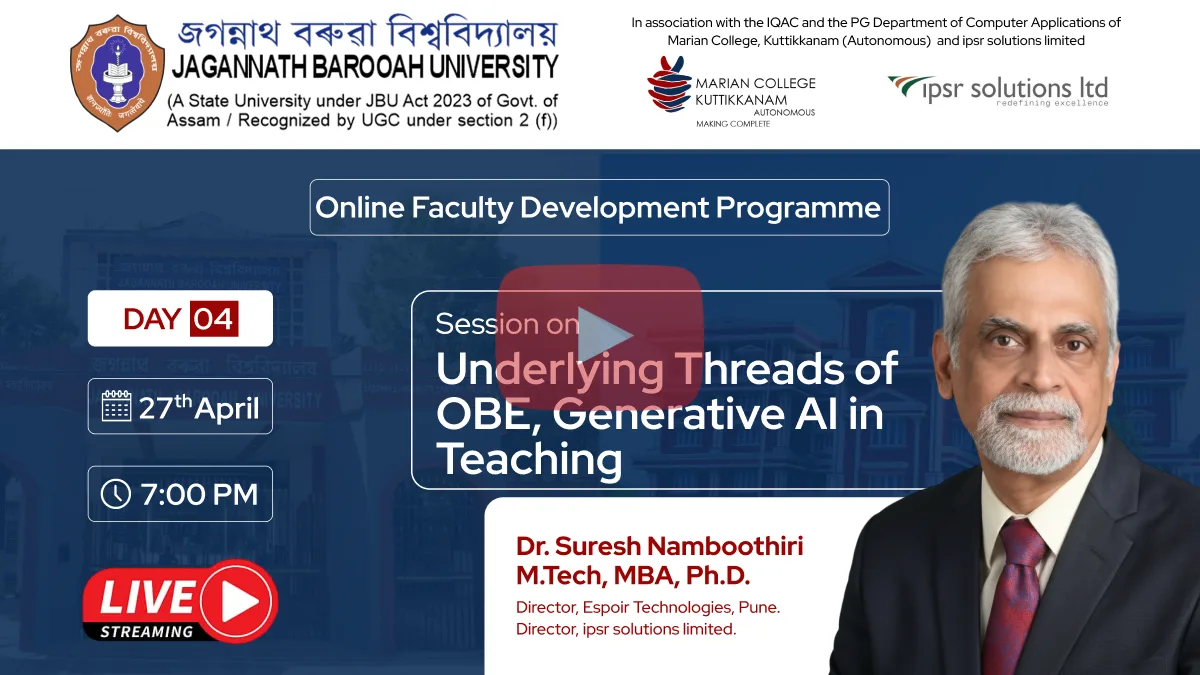
Day 4 – 27 April 2026
Topic: Underlying Threads of OBE, Generative AI in Teaching
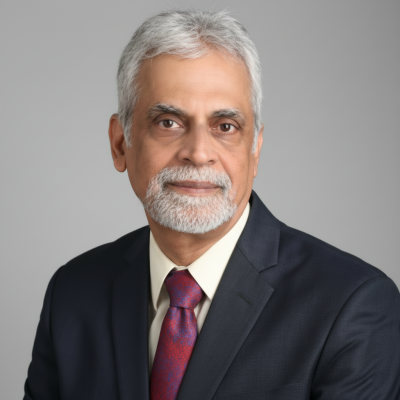
The fourth day of the Faculty Development Programme featured a technical session by Dr. Suresh Namboothiri on the integration of Outcome-Based Education (OBE) with Generative AI in higher education. The session emphasized the need to move beyond compliance-driven implementation of OBE and adopt learner-centred approaches that foster innovation, critical thinking, and real-world problem-solving.
Dr. Namboothiri highlighted the importance of designing learning experiences that extend beyond knowledge recall by integrating the cognitive, affective, and psychomotor domains of Bloom's Taxonomy. He also demonstrated how Generative AI can support educators in preparing lesson plans, creating course materials, developing rubrics and assessments, and personalizing classroom instruction. The session encouraged participants to embrace AI as a teaching assistant while ensuring that educational practices continue to develop students' analytical, creative, and problem-solving abilities.
Day 4 – Key Points
- Discussed the evolving role of Outcome-Based Education (OBE) in improving the quality and relevance of higher education.
- Emphasized the development of critical thinking and real-world problem-solving beyond knowledge recall.
- Explained the application of Bloom's Taxonomy across cognitive, affective, and psychomotor learning domains.
- Demonstrated the use of Generative AI for lesson planning, course design, rubric creation, and assessment development.
- Highlighted how AI can enhance personalized learning and improve classroom engagement.
- Encouraged educators to integrate AI responsibly while maintaining learner-centred and outcome-focused teaching practices.
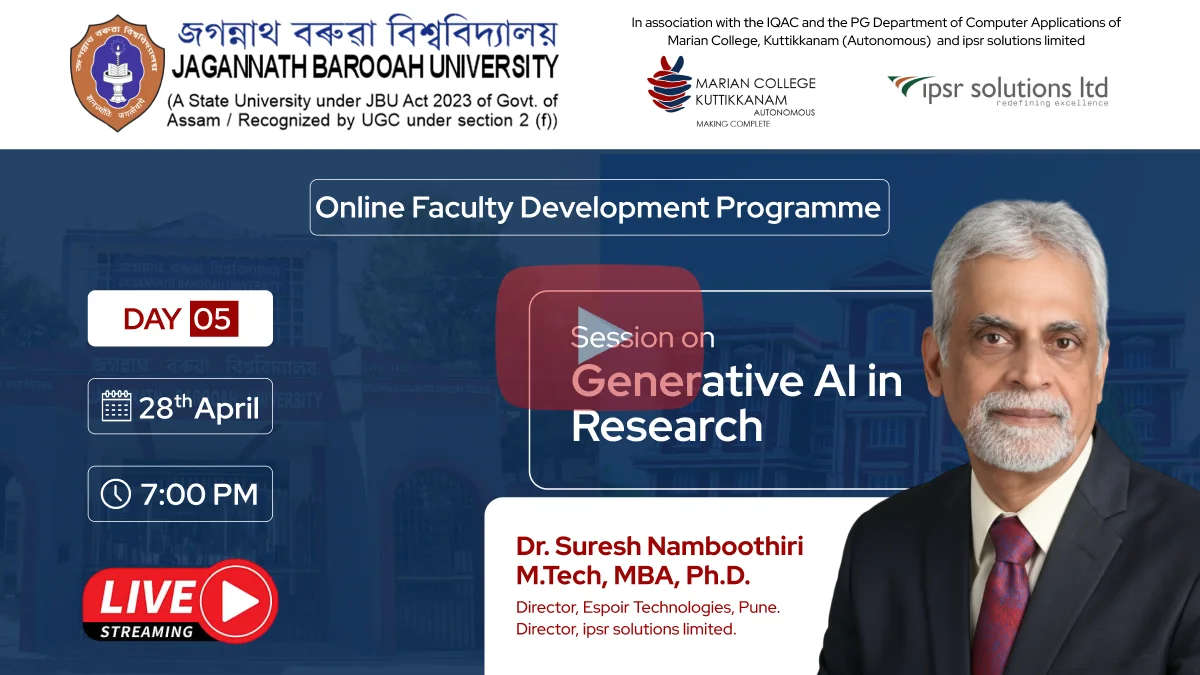
Day 5 – 28 April 2026
Topic: Generative AI in Research
Resource Person: Dr. Suresh Namboothiri
The fifth day of the Faculty Development Programme featured a technical session by Dr. Suresh Namboothiri on the Application of Generative AI in Research. The session focused on the ethical and effective use of AI throughout the research process while emphasizing that AI should enhance, rather than replace, human intellectual effort.
Dr. Namboothiri introduced the importance of prompt engineering as a critical research skill and presented the CLEVER framework—Critical Thinking, Literacy, Ethical Awareness, Versatility, Experimentation, and Result Orientation—for developing effective AI prompts. He also discussed the responsible use of AI tools across different stages of research, stressing that meaningful research requires originality, critical evaluation, and academic integrity rather than reliance on AI-generated content.
The session also introduced the Vigyana platform, which supports researchers through structured research methodology, critical thinking frameworks, and the integration of Indian Knowledge Systems (IKS) into interdisciplinary research. Participants were encouraged to prioritize research quality, originality, and impact while using AI as a collaborative research assistant to strengthen higher-order thinking and innovation.
Day 5 – Key Points
- Explored the ethical application of Generative AI in academic research.
- Introduced the CLEVER framework for effective AI prompt engineering.
- Emphasized academic integrity and discouraged the misuse of AI for shortcut research.
- Demonstrated AI tools that support various stages of the research process.
- Introduced the Vigyana platform for research methodology, critical thinking, and Indian Knowledge Systems.
- Encouraged researchers to use AI as a collaborative tool while prioritizing originality, critical thinking, and high-quality research outcomes.
Day 5 Resource
Vigyana: An AI-Powered Research Tool for Critical Thinking and Methodological Rigour
Day 6 – 29 April 2026
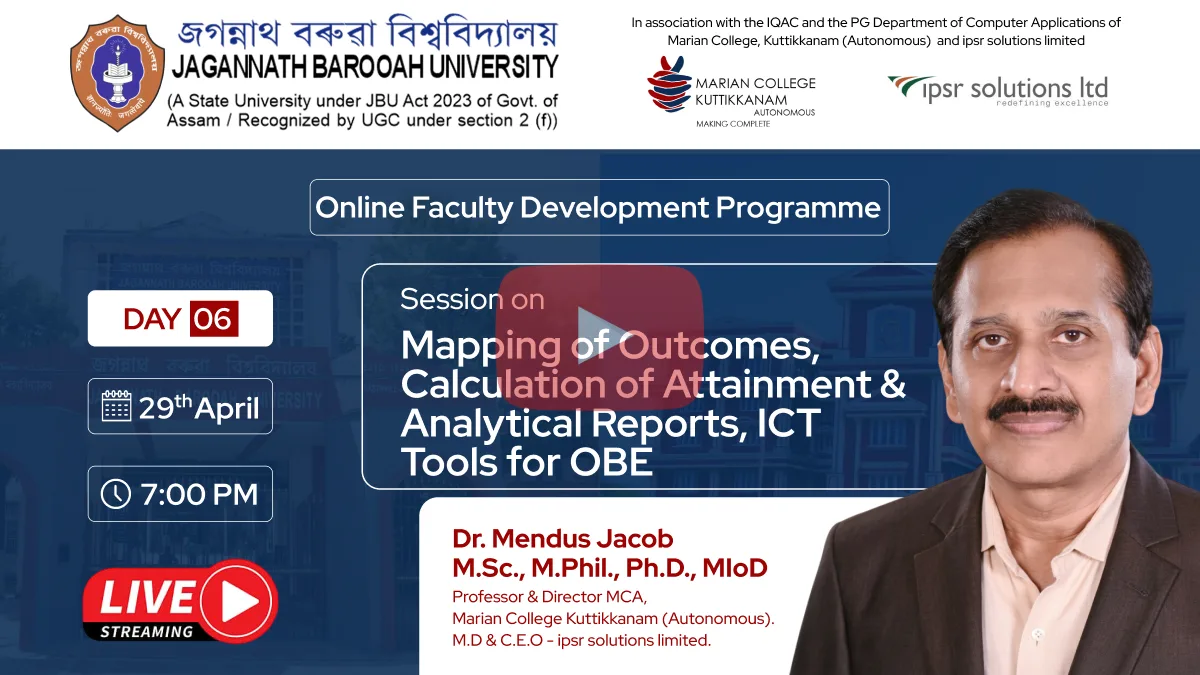
Topic: Mapping of Outcomes, Calculation of Attainment & Analytical Reports, ICT Tools for OBE
Resource Person: Dr. Mendus Jacob
Professor & Director MCA, Marian College, Kuttikkanam (Autonomous) M.D & C.E.O -ipsr solutions limited
The sixth day of the Faculty Development Programme featured a technical session by Dr. Mendus Jacob on Outcome Mapping, Attainment Calculation, and the Use of ICT Tools in Outcome-Based Education (OBE). The session provided participants with practical strategies for implementing OBE through systematic outcome mapping, assessment, and data-driven quality improvement.
Dr. Jacob explained the process of Course Outcome (CO) to Programme Outcome (PO)/Programme Specific Outcome (PSO) mapping and demonstrated how assessment activities can be aligned with Course Outcomes to measure student achievement effectively. He also discussed methods for calculating both direct and indirect attainment, highlighting the importance of using assessment data and student feedback to evaluate programme effectiveness.
The session concluded with demonstrations of ICT-enabled OBE tools that automate attainment calculations, generate analytical reports, and support continuous quality improvement. Participants also explored the use of Generative AI for developing Bloom's Taxonomy-based question banks and reducing the administrative workload involved in assessment planning.
Day 6 – Key Points
- Explained CO–PO/PSO mapping and assessment-to-CO mapping in Outcome-Based Education.
- Demonstrated methods for calculating direct and indirect attainment using assessment and survey data.
- Highlighted the role of attainment analysis in continuous quality improvement.
- Showcased ICT tools for automated OBE documentation, reporting, and student performance analysis.
- Demonstrated the use of Generative AI to create Bloom's Taxonomy-based question banks.
- Encouraged participants to apply outcome mapping and attainment tools for effective OBE implementation.
Day 6 Resource
Day 7 – 30 April 2026
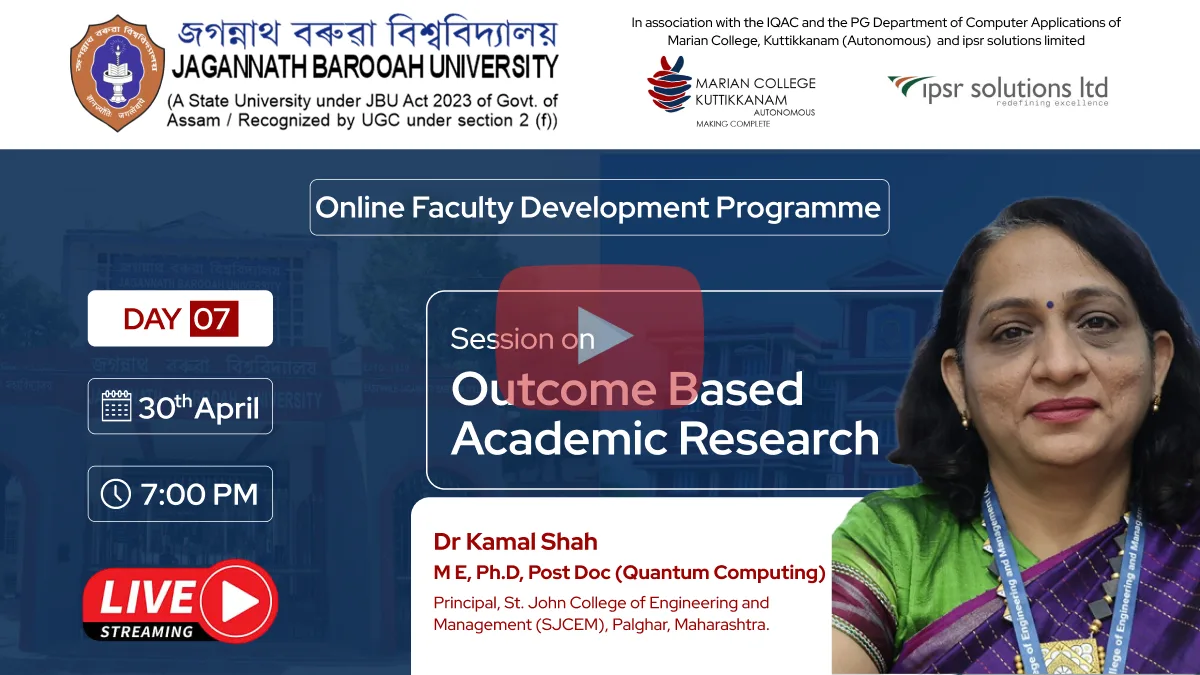
Topic: Outcome Based Academic Research

Resource Person: Dr Kamal Shah
The final day of the Faculty Development Programme focused on Outcome-Based Academic Research (OBAR), best practices in teaching and learning, and Continuous Quality Improvement (CQI). The technical session was led by Dr. Kamal Shah, who introduced the Outcome-Based Academic Research (OBAR) model. She explained how a goal-oriented approach enables faculty to design teaching, enrichment activities, and research projects that are aligned with Programme Outcomes (POs) and Course Outcomes (COs).
The session highlighted practical strategies for integrating research into classroom activities through research-based assignments, data analysis projects, and collaborative learning. Dr. Mendus Jacob demonstrated the use of digital tools and innovative teaching practices to enhance student engagement, promote academic integrity, and support effective learning. The speakers also emphasized the role of performance analysis and Continuous Quality Improvement (CQI) in strengthening teaching practices and meeting accreditation requirements.
The programme concluded with the Valedictory Session, during which Dr. Surajit Sharma expressed gratitude to the organizers, resource persons, and participants for their active involvement and successful completion of the Faculty Development Programme.
Day 7 – Key Points
- Introduced the Outcome-Based Academic Research (OBAR) model for aligning research with COs and POs.
- Demonstrated methods for integrating research activities into classroom teaching.
- Showcased digital tools and innovative teaching practices to improve student engagement and collaboration.
- Highlighted the importance of Continuous Quality Improvement (CQI) through student performance and assessment analysis.
- Emphasized the role of data-driven decision-making in enhancing academic quality and accreditation.
- Concluded with the valedictory session, marking the successful completion of the seven-day Faculty Development Programme.
Conclusion
The One-Week National Level Faculty Development Programme on Outcome Based Education (OBE) and the Application of Generative AI in Teaching and Research successfully equipped faculty members with the knowledge and practical skills required to implement learner-centred, outcome-driven education in alignment with NEP 2020. Through expert sessions, participants gained a comprehensive understanding of Outcome Based Education, including outcome design, curriculum alignment, Bloom's Taxonomy, outcome mapping, attainment calculation, and Continuous Quality Improvement (CQI).
The programme also highlighted the transformative potential of Generative AI in enhancing teaching, learning, assessment, and research. Participants were introduced to ethical AI practices, prompt engineering, AI-assisted instructional design, research support tools, and digital platforms that can improve academic productivity while maintaining academic integrity.
The interactive discussions, practical demonstrations, and hands-on activities encouraged educators to rethink their pedagogical approaches and adopt innovative strategies that foster critical thinking, creativity, and real-world problem-solving among learners. By integrating Outcome Based Education with emerging AI technologies, the programme provided a roadmap for improving educational quality, strengthening accreditation readiness, and preparing institutions to meet the evolving demands of higher education.
Overall, the Faculty Development Programme served as a valuable platform for professional growth, enabling participants to confidently implement OBE principles and responsibly leverage Generative AI to create more engaging, effective, and future-ready teaching and research environments.