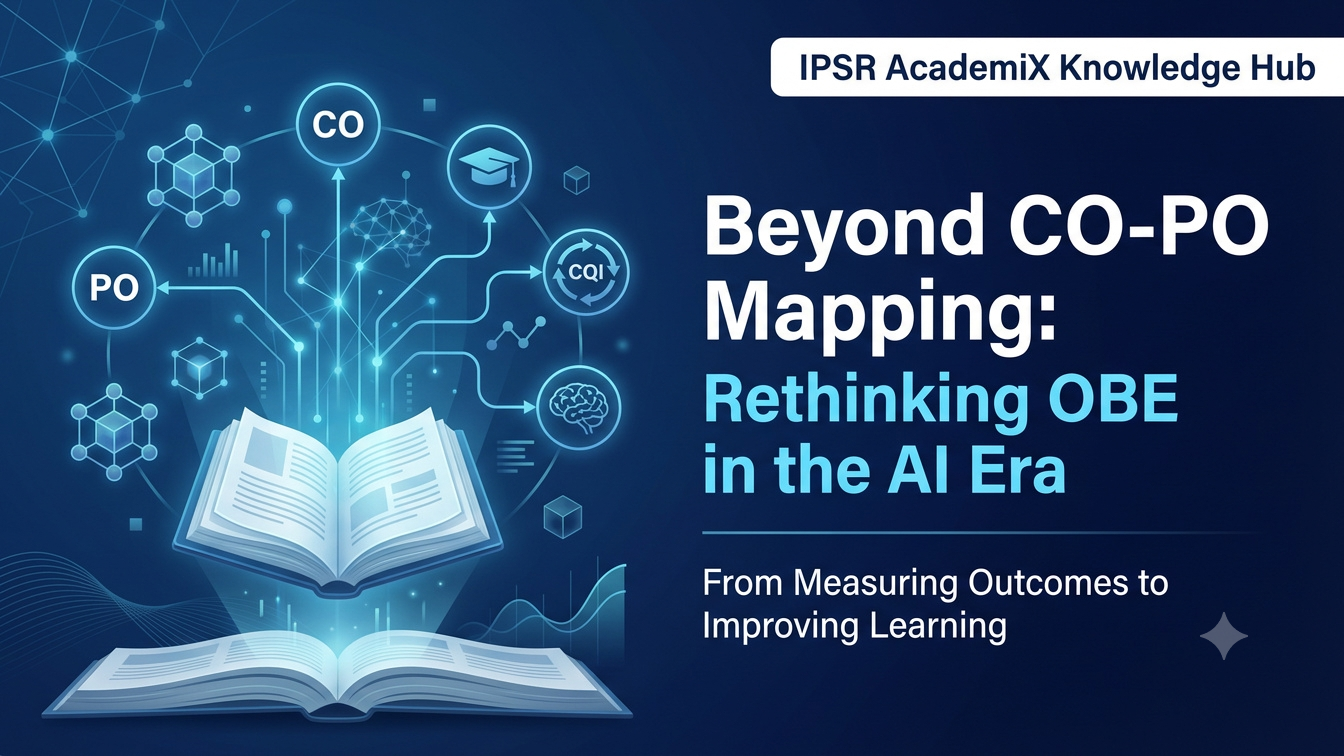
From Measuring Outcomes to Improving Learning
Introduction
Artificial Intelligence is changing how students learn, complete assignments, and demonstrate their knowledge. When AI can generate answers, write reports and solve complex problems within seconds, a fundamental question arises: Are we assessing what students genuinely know and can do, or simply evaluating what they submit?
This makes Outcome-Based Education (OBE) more relevant than ever. However, institutions must move beyond preparing Course Outcomes (COs), Programme Outcomes (POs), mapping matrices, and attainment reports.
The real purpose of OBE is not to generate evidence of learning, but to use that evidence to improve learning.
1. Beyond CO–PO Mapping: Are We Measuring the Right Outcomes?
CO -PO mapping is an essential foundation for OBE. It connects what students learn in individual courses with the broader competencies expected from a graduate.
But in the AI era, institutions must revisit an important question: Are our learning outcomes still relevant to the world our students are entering?
Along with subject knowledge, students increasingly need to demonstrate critical thinking, problem-solving, creativity, ethical judgement, and the ability to work responsibly with AI.
For example, instead of expecting students to explain a concept, we could ask them to apply it to a real-world problem, evaluate possible solutions, and justify their decisions.
The focus must shift from what students can reproduce to what they can understand, apply and demonstrate independently.
2. Rethinking Assessment in the AI Era
Traditional examinations, assignments and projects continue to have their place. However, AI-generated responses make it increasingly difficult to judge student understanding from submitted work alone.
Institutions need to rethink how outcomes are assessed.
Some practical approaches include:
-
Application-based assessments: Ask students to solve real-world problems rather than reproduce textbook answers.
-
Authentic assessments: Use case studies, practical tasks, projects and simulations that reflect professional situations.
-
Process-based evaluation: Assess how students approach a problem, make decisions and justify their conclusions.
-
AI-aware assessment: Allow appropriate AI use while requiring students to critically evaluate, verify and explain AI-generated outputs.
-
Continuous assessment: Use classroom interactions, presentations, demonstrations and formative feedback to understand individual learning progress.
For example, instead of asking students to submit an AI-generated project report, ask them to explain their design decisions, demonstrate the solution and defend their findings.
The objective is not to eliminate AI from assessment, but to ensure that learning remains visible and measurable.
3. Moving from Attainment Calculation to Learning Improvement
Many institutions calculate CO and PO attainment regularly. But what happens after the attainment report is prepared?
Consider a course where students achieve good marks in examinations but struggle to apply the same concepts in practical situations.
A conventional approach may report satisfactory attainment. A meaningful OBE approach would investigate why students are unable to apply what they have learned.
Institutions should use direct evidence from examinations, practical work, projects and demonstrations, supported by indirect evidence such as student, graduate and employer feedback.
Attainment analysis should help faculty answer three simple questions:
-
What have our students achieved?
-
Where are they struggling, and why?
-
What should we change to improve their learning?
This is where OBE becomes a tool for academic improvement rather than an exercise in numerical reporting.
4. Closing the Loop: The Heart of Effective OBE
Continuous Quality Improvement (CQI) is meaningful only when assessment findings lead to action.
The process can be simple:
Define → Assess → Analyse → Improve → Review
For example, if students consistently perform poorly in problem-solving, faculty may introduce more case-based discussions, guided practice or collaborative activities.
The next assessment cycle should then examine whether these interventions improved student performance.
Closing the loop is not about documenting the action taken. It is about demonstrating whether the action made a difference.
This distinction is particularly important for institutions seeking to strengthen academic quality and accreditation readiness.
5. Using AI and Technology to Strengthen OBE
Technology can make OBE more efficient, consistent and meaningful.
Digital platforms can support CO–PO mapping, question paper analysis, assessment management, attainment calculation and academic reporting.
AI can extend these capabilities by helping faculty:
-
Review the alignment of questions with learning outcomes and Bloom's cognitive levels.
-
Identify possible gaps in assessment coverage.
-
Analyse student performance patterns and areas requiring intervention.
-
Develop differentiated learning activities and formative assessments.
-
Reduce repetitive documentation and reporting work.
However, AI-generated analysis must support, not replace, faculty judgement. Academic decisions should remain grounded in validated evidence, institutional policies and professional expertise.
The real opportunity is to spend less time preparing reports and more time understanding and improving student learning.
6. From Accreditation Compliance to Academic Excellence
OBE should not become an activity undertaken mainly for accreditation visits.
Frameworks such as NBA emphasize outcome attainment and continuous improvement. But institutions should view these requirements as opportunities to strengthen their everyday academic practices.
An effective OBE system should help institutions demonstrate:
-
Whether students are achieving the intended competencies.
-
Whether assessments genuinely measure those competencies.
-
Whether identified learning gaps lead to appropriate interventions.
-
Whether those interventions result in measurable improvement.
When institutions can answer these questions with credible evidence, OBE becomes part of their academic culture rather than a documentation requirement.
Conclusion: OBE Must Evolve with the AI Era
AI is challenging many of our traditional assumptions about teaching, learning and assessment.
Students now have access to powerful tools that can generate information and solutions instantly. What matters increasingly is their ability to think critically, apply knowledge, question information, make responsible decisions and solve unfamiliar problems.
This calls for institutions to revisit not only how they teach, but also what they expect students to learn, how they assess learning and how they use assessment evidence for improvement.
The future of OBE is not about producing more mapping matrices or sophisticated attainment reports.
It is about making learning more meaningful, assessment more authentic and academic improvement more measurable.
AcademiX: Supporting the Next Phase of OBE
At AcademiX, an academic solutions initiative by IPSR, we believe that meaningful OBE implementation requires more than technology. It needs sound academic practices, faculty empowerment, and a sustained commitment to improving student learning.
Through faculty development, OBE implementation support and technology-enabled academic solutions, AcademiX helps higher education institutions move from documentation-driven processes towards evidence-based academic improvement.
Let's move beyond measuring outcomes to transforming learning in the AI era.
Explore: https://ipsrsolutions.com/