
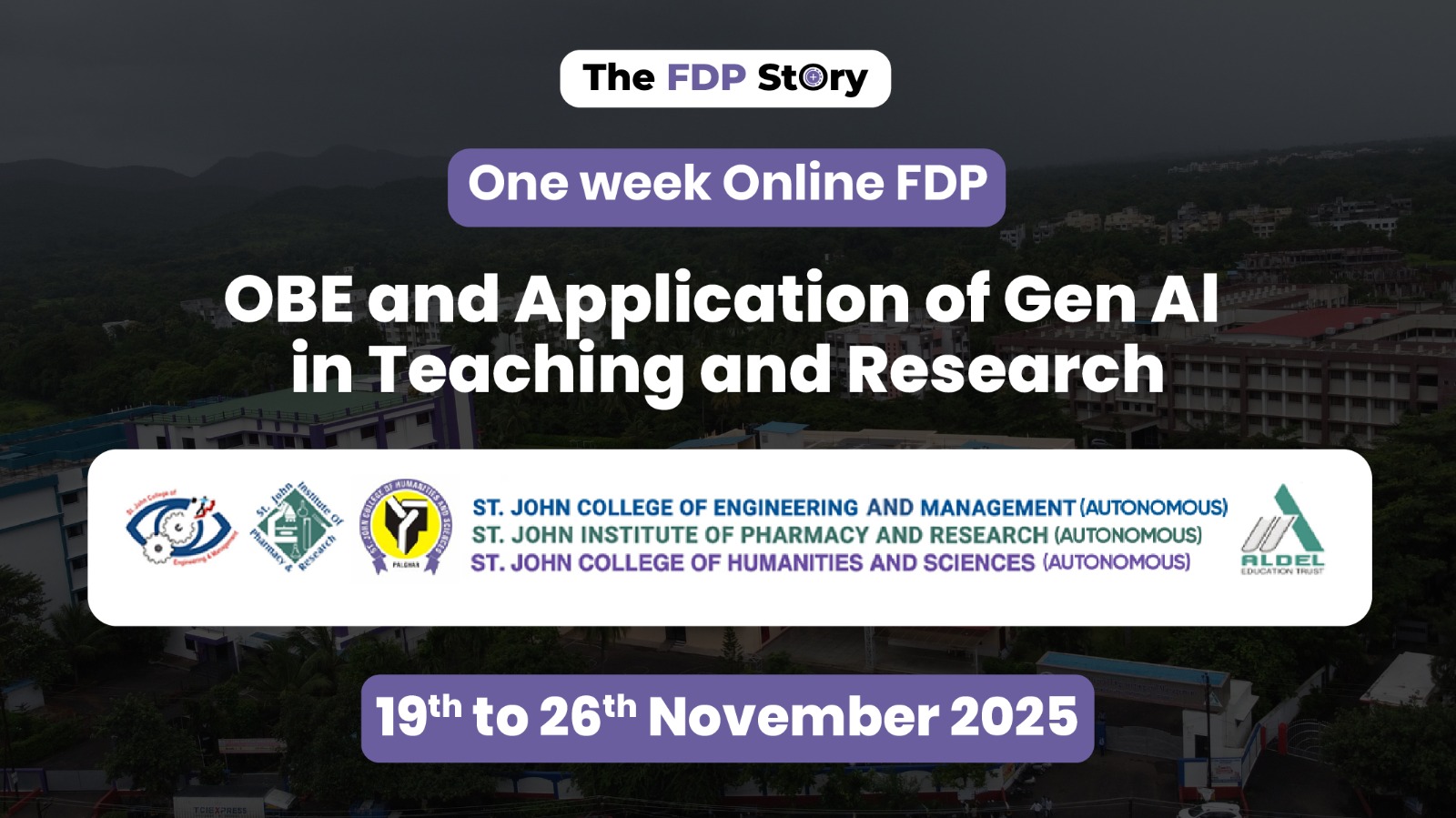
The One-week National-level Online Faculty Development Program (FDP) on Outcome Based Education (OBE) and the Application of Generative AI in Teaching and Research was organised by St. John Technical & Educational Campus, Palghar, Maharashtra, in association with ipsr solutions limited.
Held from 19th to 26th November 2025 in an online mode, this FDP brought together educators from across the country to explore modern academic frameworks, AI-driven teaching methodologies, and innovative approaches for improving the quality of higher education.
Over 5,000 participants have registered for this groundbreaking FDP, making it a major success.
St. John Technical & Educational Campus (SJTEC), under the Aldel Education Trust, is a renowned educational institution in Palghar, Maharashtra, committed to excellence in technical, professional, and higher education. The campus hosts multiple institutions, including St. John College of Engineering & Management (SJCEM), St. John Institute of Pharmacy & Research (SJIPR), Aldel Institute of Management (AIM), St. John College of Humanities & Sciences (SJCHS), and St. John Polytechnic.
With its vision of “Excellence in Serving to Educate and Educating to Serve,” SJTEC continuously works toward equipping educators and students with contemporary knowledge and industry-ready competencies.
ipsr solutions limited is a public limited IT company with 25+ years of leadership in academic transformation, OBE automation, AI-driven learning tools, and accreditation support. IPSR has trained over 45,000 faculty members and collaborated with 500+ Higher Education Institutions across India and abroad. Their innovative platforms QnSmarti, QuestionPaper.ai, deQ OBE, Acharya, and Vigyana, support digital transformation in teaching, learning, assessment, and research.
Together, SJTEC and IPSR conducted a transformative one-week FDP on Outcome Based Education and Generative AI, empowering thousands of educators across India to reimagine academic delivery, assessment frameworks, and research practices in an AI-driven era.
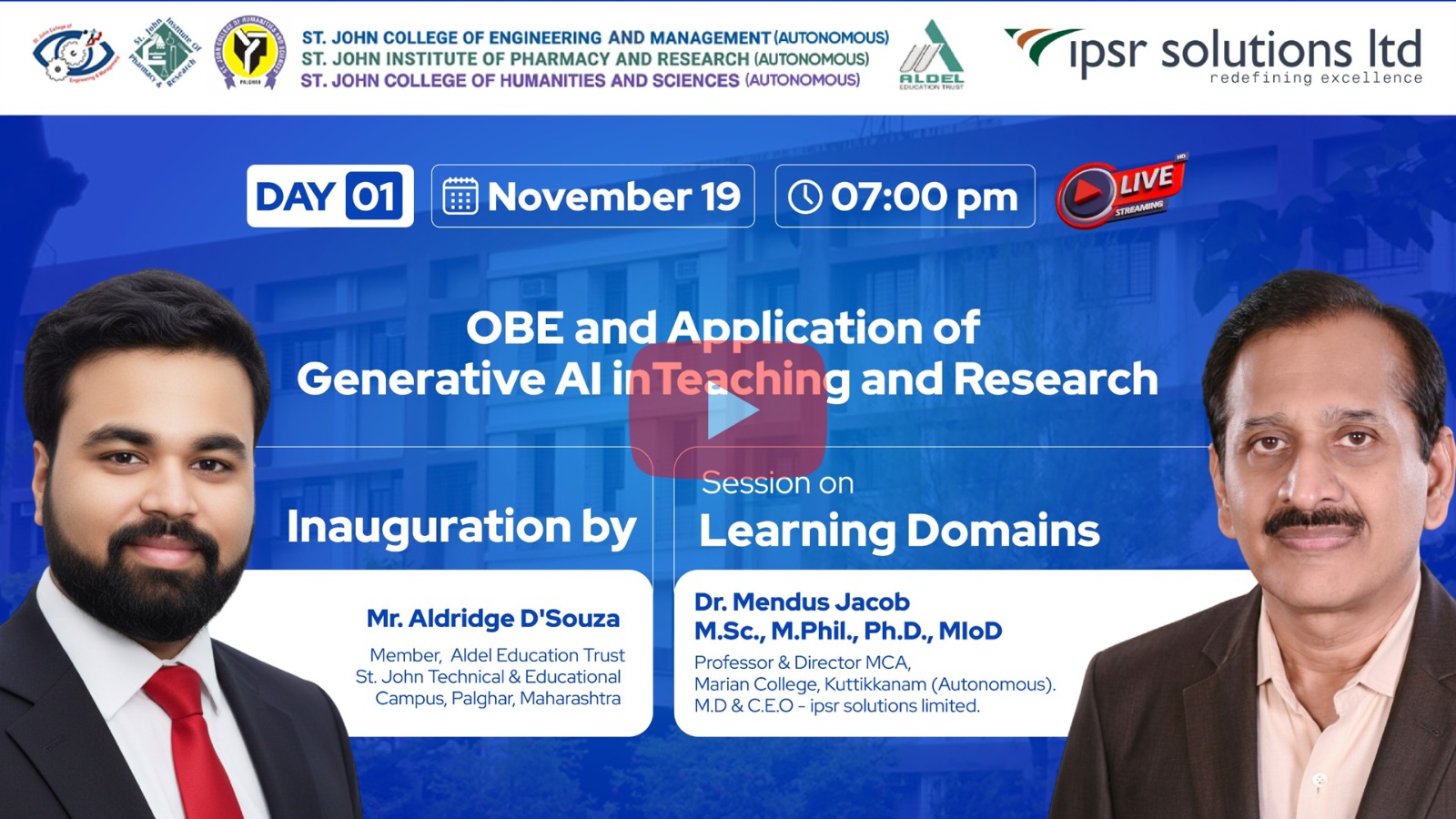
The FDP opened with a warm and inspiring inauguration by Mr. Aldridge D’Souza, Member of Aldel Education Trust, who welcomed participants and highlighted the growing need for AI-integrated and outcome-focused academic practices. His message set a strong foundation for the transformative learning journey ahead.
This was followed by an insightful technical session by Dr. Mendus Jacob, Professor & Director, MCA, Marian College, Kuttikkanam (Autonomous) and MD & CEO of ipsr solutions limited. In this session, Dr. Mendus introduced the fundamental concept of Learning Domains based on Bloom’s Taxonomy. He explained how the Cognitive (knowledge), Affective (attitudes) and Psychomotor (skills) domains work together to support the principles of Outcome-Based Education. Through clear examples and practical insights, he guided educators on designing learning outcomes and teaching–learning–assessment strategies that align with modern academic expectations.
Watch the recording to understand how Bloom’s Taxonomy strengthens OBE implementation and supports effective curriculum design.
QnSmart i 4.0 – OBE aligned and AI-Assisted Question Bank Software for Universities & Autonomous Colleges by IPSR
During the session, Dr. Mendus Jacob introduced QnSmarti 4.0, explaining how this advanced platform can significantly reduce faculty workload and streamline the entire process of academic question management. Participants were taken through a detailed walk-through of the tool, which is IPSR’s AI-assisted system designed to generate high-quality, outcome-aligned assessments with remarkable speed and accuracy.
The walk-through showed how educators can instantly create question banks and CO-aligned question papers. QnSmarti 4.0 automatically tags questions with Bloom’s Taxonomy levels, maps them to Course Outcomes, and ensures constructive alignment across teaching, learning and assessment. With rapid question generation, intuitive workflows and built-in quality validation, the tool empowers faculty to save time, improve consistency and strengthen OBE implementation.
To explore QnSmarti further visit the QnSmarti 4.0 Website Page
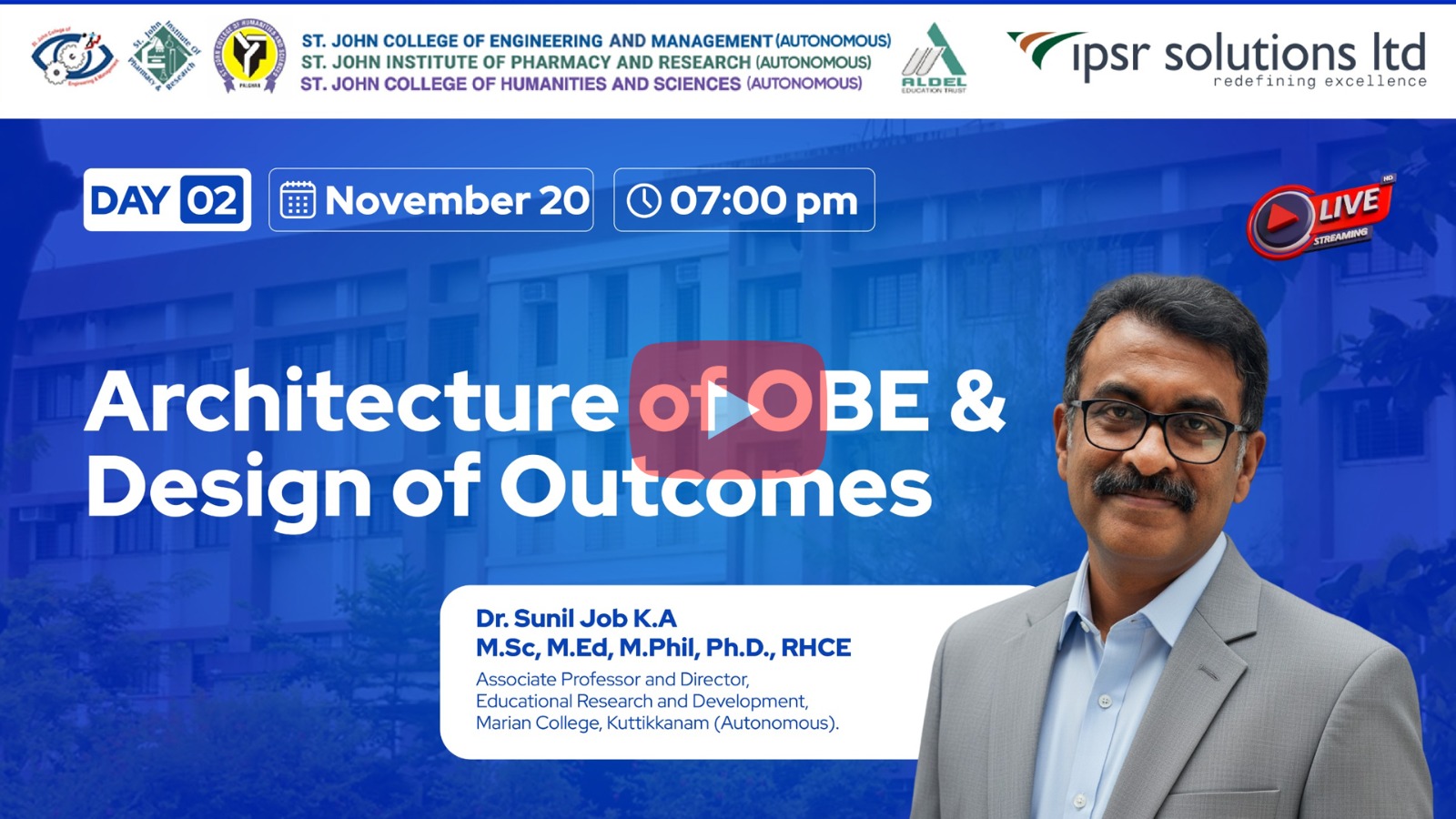
Day Two offered a deep dive into the architecture of Outcome-Based Education, led by Dr. Sunil Job K.A, Chief of Academic Solutions at IPSR and Associate Professor & Director of Educational Research and Development at Marian College, Kuttikkanam (Autonomous). The session began with a quick recap of Bloom’s Taxonomy before moving into the core components of OBE, including the shift from traditional models to learner-centered outcome-focused education.
Dr. Sunil explained the Learning Map of OBE; Vision, Mission, PEOs, POs, COs and LOs and guided participants on writing effective Course Outcomes using the structure of Action Verb, Learning Content and Context. The session also covered evaluating COs using the SMART criteria, ensuring clarity and measurability in curriculum design.
Watch the Day 2 session recording for a complete understanding of OBE architecture and outcome design.
During the session, participants were introduced to QuestionPaper.ai, an AI-powered platform that makes it incredibly easy for faculty to generate OBE-focused question papers with accuracy and speed. The tool maps Course Outcomes, applies Bloom’s Taxonomy levels, and supports multiple question formats like MCQs, T/F, fill-in-the-blanks, short and long answers ensuring structured and outcome-aligned assessments.
QuestionPaper.ai supports ready-made and customizable templates, accepts syllabus input in multiple formats (text, JPEG, PNG, PDF), and allows full editing of AI-generated questions. With support for 100+ languages, images, tables and diagrams, it caters to a wide range of disciplines. The platform also generates an automatic answer key, helping faculty save time while maintaining academic quality.
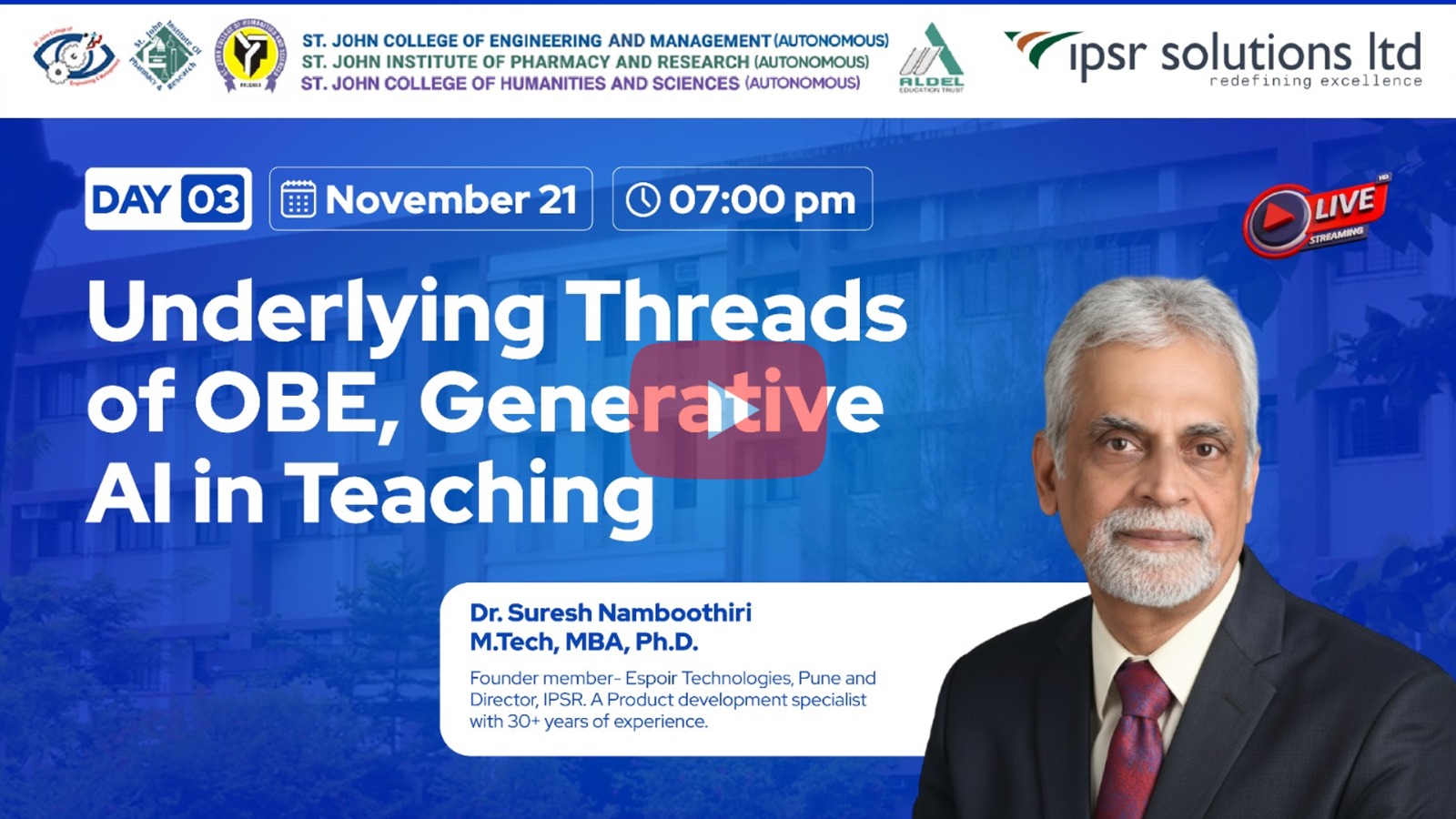
Day Three was led by Dr. Suresh Namboothiri, who delivered a powerful session exploring the deep connection between India’s education challenges, Bloom’s Taxonomy and the rising influence of Generative AI. He highlighted how gaps in innovation, weak research culture and reliance on external technologies stem from graduates functioning at lower cognitive levels.
Dr. Namboothiri explained the evolution of Bloom’s Taxonomy, the four types of knowledge and the need for strong mental infrastructure to help learners interpret, analyze and create. He emphasized the importance of building higher-order thinking and integrating the three domains of Bloom’s Taxonomy; Head (Cognitive), Heart (Affective) and Hand (Psychomotor) to prepare learners for an AI-driven future.
Watch the full Day 3 recording to explore Dr. Namboothiri’s insights on OBE and Generative AI.
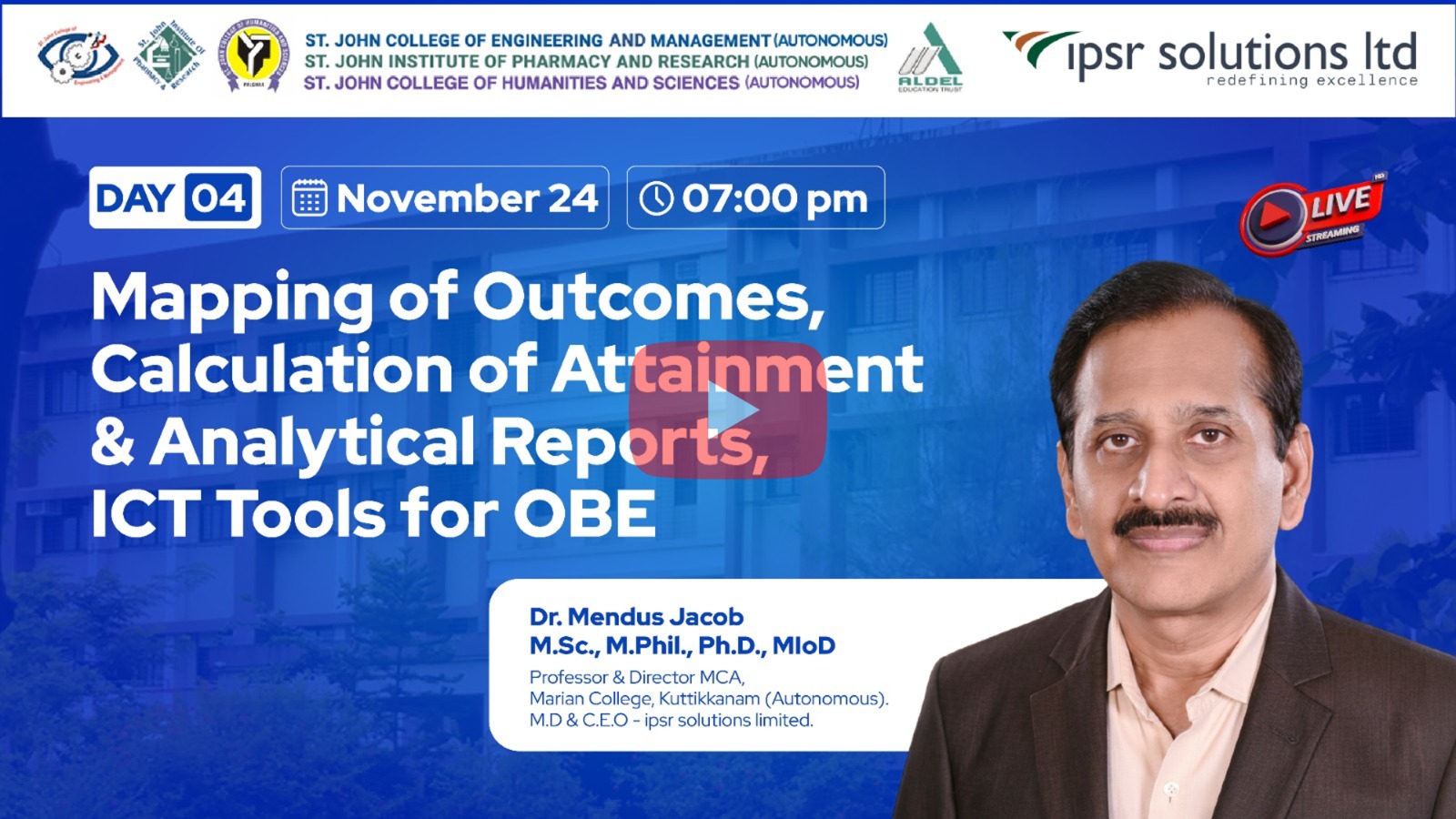
Day Four, led by Dr. Mendus Jacob, focused on the practical processes involved in mapping outcomes and calculating attainment within an OBE framework. The session provided clarity on Level 1 and Level 2 mapping, helping participants understand how COs connect to POs, PSOs and teaching–learning activities.
Dr. Mendus guided participants through the methods of mapping assessment questions to Course Outcomes and explained how to compute CO and PO attainment using continuous assessments, semester-end exams and indirect assessment data. The session also introduced analytical reports, CQI practices and ICT tools that simplify OBE implementation through dashboards, automated calculations and data-driven insights.
Watch the Day 4 recording for the complete walkthrough on mapping and attainment calculation.
deQ OBE – Overview
During the session, participants were introduced to deQ OBE, an ICT-enabled platform that automates and simplifies the entire Outcome-Based Education workflow. The tool supports faculty in outcome mapping, CO-PO alignment, assessment planning and attainment calculation, making OBE implementation accurate and effortless.
deQ OBE allows educators to upload Course Outcomes, set target attainment levels, link assessments to COs and automatically compute attainment for individual students and batches. It also generates powerful analytical reports, including CO, PO and PSO attainment summaries, outlier analysis and slow learner identification supporting Continuous Quality Improvement and accreditation processes.
To explore deQ OBE further visit the deQ OBE Website Page
deQ OBE Essentials
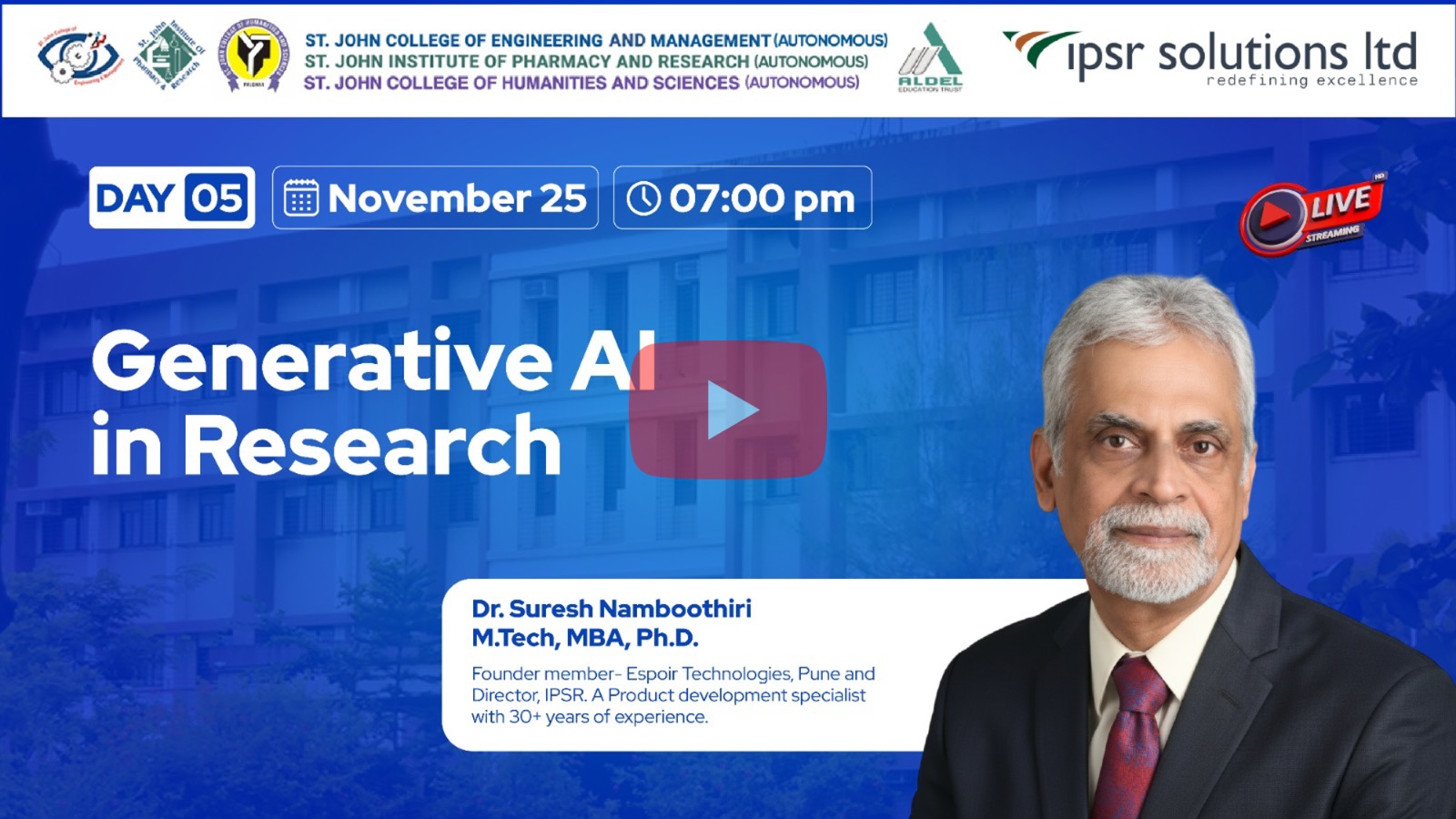
Day Five featured a powerful session by Dr. Suresh Namboothiri, who explored how Generative AI is reshaping research and why meaningful, high-impact research must go beyond tool usage. He explained that true research value comes from strong ideas, clarity of purpose and higher-order thinking areas where many scholars struggle.
Through relatable examples, he highlighted common challenges faced by Indian researchers, the limitations of foreign AI tools, and the need for culturally relevant research support systems. Dr. Namboothiri also introduced core Critical Thinking frameworks like Intellectual Standards, Elements of Reasoning and Intellectual Traits showing how they strengthen ideation, problem formulation and the overall research process.
This conceptual foundation led to the introduction of Vigyana, an AI platform created specifically to support Indian research scholars with idea generation, critical thinking and structured research methodology.
Watch the Day 5 session recording to explore these insights and understand how AI and critical thinking can transform research quality.
In the second half of the session, participants were introduced to Vigyana, an AI-powered research platform designed specifically for Indian research scholars. Dr. Suresh Namboothiri explained how Vigyana goes far beyond bibliometric tools by offering a context-aware, structured environment for generating and refining research ideas.
Vigyana is built around four key sections Research & Publication Ideas, Critical Thinking & Investigation, Research Methodology and the Indian Knowledge System (IKS). The platform helps scholars fine-tune ideas using a 21-module validation system, follow a clear logical flow of research and apply higher-order thinking tools inspired by innovative thinkers. It also supports ethical report generation, citations, data analysis and customizable academic outputs.
To explore deQ OBE further visit the Vigyana AI Tool for researchers
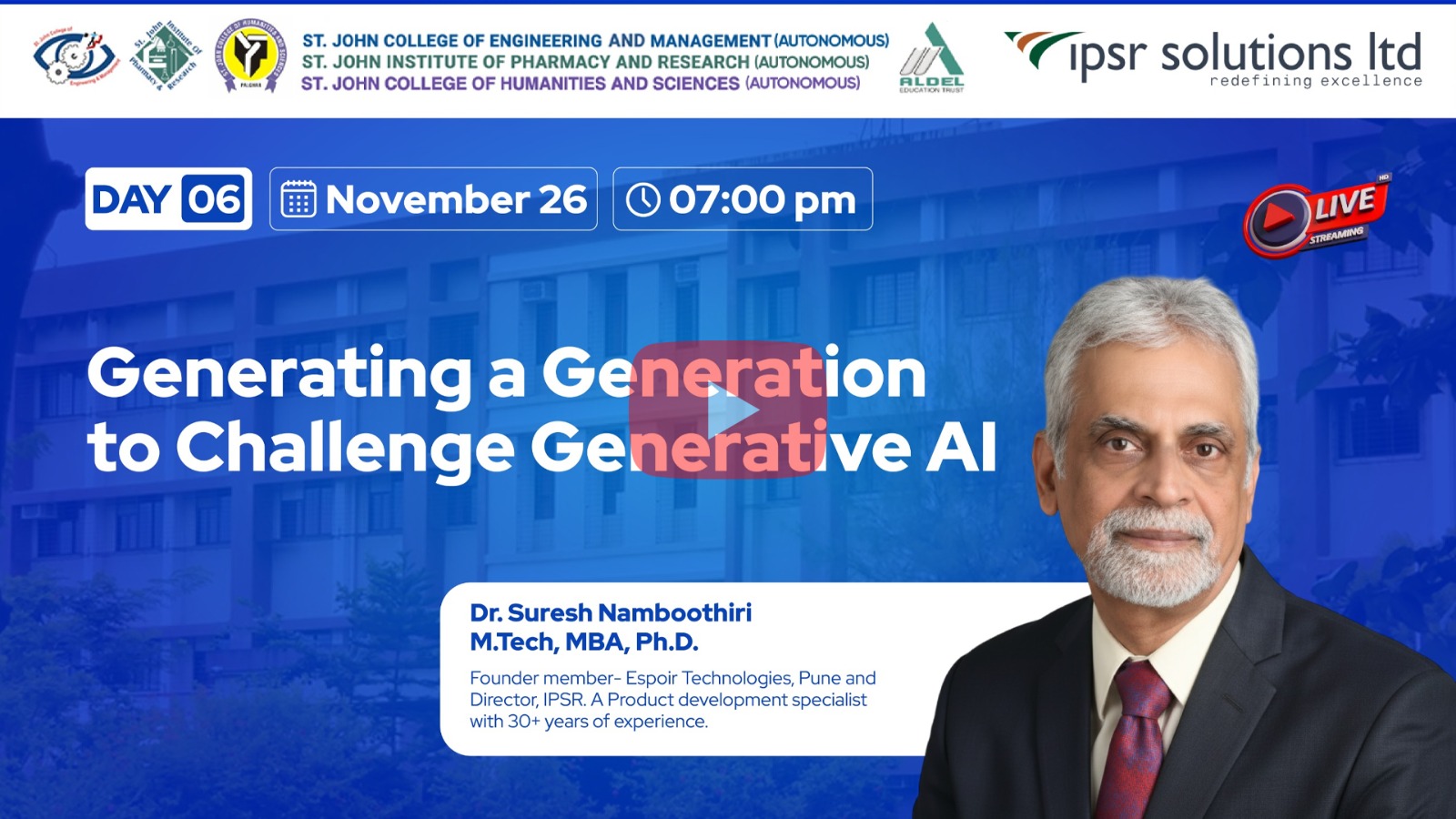
Day Six, led by Dr. Suresh Namboothiri, explored one of the most forward-looking themes of the FDP: how education must evolve to prepare learners for a world dominated by Generative AI. Dr. Namboothiri examined the rapid rise of tools like ChatGPT, the concerns of academicians, institutions, parents and students, and the growing disconnect between university responses and the actual magnitude of the AI challenge.
Through real-world examples and thought-provoking analogies, he highlighted how academic integrity, employability and cognitive development are being reshaped. Instead of competing with AI at a cognitive level, Dr. Namboothiri emphasized the need to strengthen irreducible human competencies; skills rooted in emotion, creativity, moral judgment and experiential learning.
Participants were introduced to the Eight AI-Irreplaceable Competencies and the Applied Critical Thinking Framework, both essential for designing future-ready learners. This set the context for the introduction of Bloom’s OBE Lab, a platform aimed at helping institutions practically build these competencies.
Watch the full Day 6 recording to understand the complete discussion, examples and the strategic shift required in AI-era education.
The second part of the session introduced Bloom’s OBE Lab, a platform designed to help institutions build AI-resistant human competencies by integrating the Cognitive, Affective and Psychomotor domains of Bloom’s Taxonomy into practical learning experiences. Dr. Suresh Namboothiri explained how the tool supports faculty in creating activities that develop higher-order thinking, emotional intelligence, real-world decision-making and hands-on skills; areas where AI cannot replace human capability.
Participants were shown how Bloom’s OBE Lab aligns with the Eight AI-Irreplaceable Competencies discussed earlier in the session, positioning the platform as a future-ready solution for the Generative AI era.
The One-week National-level FDP successfully equipped educators from across the country with the knowledge and tools needed to adopt Outcome-Based Education and Generative AI in teaching, assessment, and research.
Through expert-led sessions, hands-on LMS activities, product demonstrations, and continuous academic engagement, the program enabled participants to rethink their teaching practices and embrace technology-driven academic transformation.
This FDP held special significance as it formed a key part of ipsr solutions limited’s Silver Jubilee Year celebrations. As a gesture of gratitude to the academic community, IPSR sponsored the entire program, offering it completely free of cost to all participants and faculty members across institutions.
Over the past 25 years, IPSR has mentored more than 1,00,000 students and trained around 50,000 faculty members in Outcome-Based Education. This milestone reinforces our commitment to serving the education sector and empowering educators with the competencies to integrate OBE and AI into Teaching, Learning, and Assessments.
The collaboration between St. John Technical & Educational Campus and ipsr solutions limited stands as a powerful example of how institutions and industry partners can work together to build a future-ready academic ecosystem. As we move ahead, IPSR remains dedicated to supporting educators, strengthening academic quality and fostering innovation across higher education.

Join us for FREE to get instant email updates!
The Internal Quality Assurance Cell (IQAC), in collaboration with the […]
A one-day workshop on Demystifying Outcome-Based Education (OBE) was successfully […]
As part of Mar Athanasius College of Engineering’s continuous pursuit […]
A one-day workshop on Smart Assessments with the OBE Approach […]
A one-day national-level workshop on Demystifying Outcome-Based Education (OBE) was […]
The Faculty Development Programme on Outcome Based Education (OBE) was […]

St. John Group of Institutions, under the Aldel Education Trust, […]
MES KEVEEYAM College, Valanchery, Malappuram, successfully hosted a One-Day National […]
As part of Parul University’s continued commitment to enhancing academic […]
Introduction GEMS Arts and Science College, Malappuram, successfully hosted a […]








Leave A Comment